
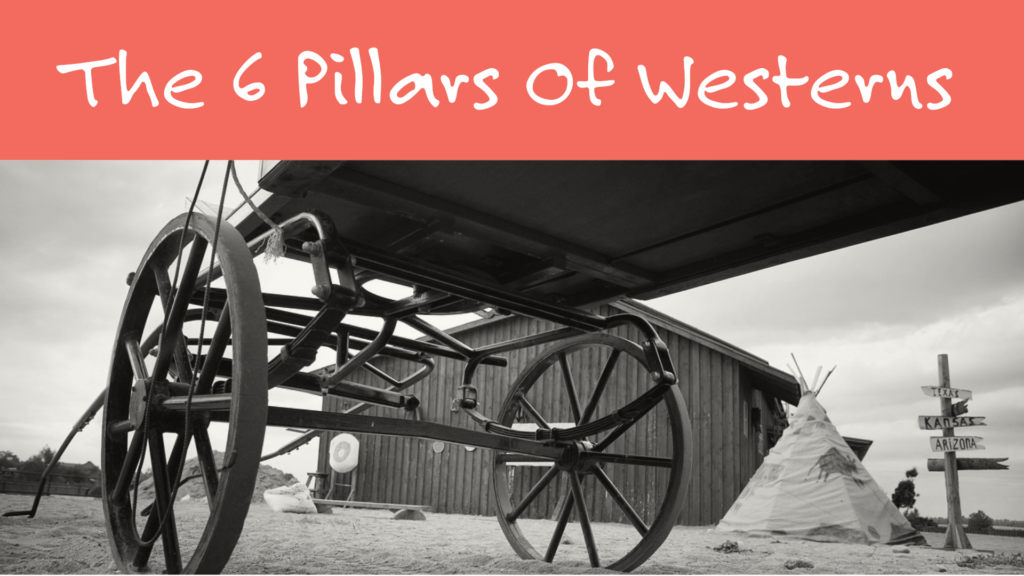
Are you writing a Western? In this post, we look at how using the 6 pillars of Westerns can improve your story.
We have written about:
- The 3 Pillars Of Horror
- The 4 Pillars Of Fantasy
- The 4 Pillars Of Romance
- The 5 Pillars Of Family Sagas
- The 5 Pillars Of Thrillers
- The 4 Pillars Of Literary Fiction
- The 4 Pillars Of Science Fiction
- The 5 Pillars Of Police Procedurals
- The 4 Pillars Of New Adult Fiction
- The 4 Pillars Of A Memoir
- The 5 Pillars Of Action-Adventure
- The 4 Pillars Of Magic Realism
- The 6 Pillars Of Westerns
- The 4 Pillars Of Women’s Fiction
- The 7 Pillars Of Historical Fiction
- The 5 Pillars Of Speculative Fiction
- The 6 Pillars Of Young Adult Fiction
In this post, we will be exploring the six pillars of Westerns. (Click on pillars to find out what a pillar is.)
What Is A Western?
The Western is a genre of fiction typically set in the American frontier. It is mostly referred to as the ‘Wild West’. The stories feature cowboys, sheriffs, and outlaws, and have themes that include justice, the struggle for survival, revenge, and frontier life. Stories feature a male drifter, cowboy, or gunslinger who rides a horse into town. He is always well-armed – usually with a revolver or rifle. Modern Westerns take place in a modern setting but still use the storylines, characters, and themes that are found in the old Westerns. The Western is still a popular genre today.
Westerns have come a long way since The Last of the Mohicans by James Fenimore Cooper written in 1826 to Cowboys And Aliens hit our screens in 2011. In between, we’ve had classics such as the 1985 Lonesome Dove by Larry McMurtry, which won the 1986 Pulitzer Prize in Fiction. According to The New York Times, it was ‘the great cowboy novel’. Others include the 1912 Riders Of The Purple Sage by Zane Grey, the 1949 Shane by Jack Shaefer, considered by many as the best Western of all time. In 1964, Thomas Berger wrote Little Big Man.
Westerns are considered ‘easy to write’, but as with any genre, ‘easy’ doesn’t necessarily mean ‘good’. As a result, many plot-short, pulp-fiction westerns were churned out during the heyday of the genre.
Among the ‘good’ was the author, Louis L’Amour. He was the most prolific Western author of all time. He wrote 100 novels, 250 short stories, and sold 320 million copies of his books. Zane Grey came in second.
So, on what pillars is a classic Western constructed?
The 6 Pillars Of Westerns
Pillar 1 – The Time Period
From the fur trade in the early 1500s in Canada, the mountain men era which peaked between 1820 and 1830, the Louisiana Purchase in 1803, the gold rush of 1840, to the wagon train era of 1840s to the 1860s – all of these provide great fodder for Westerns.
Modern Westerns – those set in the very recent past – such as Cormac McCarthy’s 2005 No Country For Old Men do exist. But the typical Western is usually set just after the American Civil War from 1861 to 1900.
Michael Blake’s Dances With Wolves, is a prime example of the time-period and the loner hero. While many of the older Westerns portray the Native Americans as the villains, Dances With Wolves does the opposite. If you’ve read Bury My Heart At Wounded Knee by Dee Brown, you’ll know who the villains are.
Dances With Wolves book quote: In trying to produce my own death, I was elevated to the status of a living hero.
Pillar 2 – The Location
The Last Of The Mohicans, set in 1757, took place in the wilderness of upstate New York. Other Westerns are set in British Columbia, Canada.
In general, Westerns take place west of the Mississippi River and up to and including the Rocky Mountains. Hot, dry scrubland is a favourite setting for a reason. If you put someone, male or female into an arid region, the landscape becomes another character. Snowstorms are another favourite for Westerns for the same reason.
A.B. Guthrie Jr.’s The Big Sky’s strength lies in the fact that through the almost poetically descriptive style you’ll feel the same pull to the land, during the years 1830 to 1843, that the mountain men experienced.
The Big Sky book quote: It made a man little and still big, like a king looking out.
Pillar 3 – Human Resilience
In early TV Westerns, the plots were so thin that it was hard to tell who the goodies and the baddies were. The producers made it easy – baddies wore black hats, and the goodies wore white ones. Sometimes the books follow this same type of formula. The reverse is also true and have, in many cases, become predictable tropes – the prostitute with the heart of gold being one of them.
There is a large pool of characters to draw from when you write a Western. Some are obviously bad guys, sometimes they can be reformed bad guys, some are heroes that have been pushed to act like bad guys. They can include cattle rustlers, gunslingers, corrupt sheriffs, land barons, cattle barons, card sharks, and outlaws. Heroes are usually loners, sheriffs, doctors, reformed gunslingers, or are men trying to turn over a new leaf. They are usually seen coming to the rescue of a town, a widow, a ranch etc. Female characters are either schoolteachers, widows, daughters, or prostitutes that need rescuing in one way or another.
Memorable Westerns are primarily about resilience. The landscape helps to frame the plots. Tough environments make tough people. Not only do the characters have to battle or tame the landscape – if possible, they also must battle the hardest of human emotions the landscape can cause. Any of the physical or human dangers the characters face could result in loss, grief, and death. Which is why It doesn’t really matter who the character is, what matters is how they navigate the harshness of the frontier. One of the best examples of this is Lonesome Dove.
Lonesome Dove book quote: It was as if his whole life had suddenly lodged in his throat, a raw bite he could neither spit out nor swallow.
Pillar 4 – Natural Dangers
Another aspect of the landscape are the natural dangers of the Western environment. It would include rattlesnakes, bears, wolves, bison, drought, sun-stroke, broken bones, flash floods, freezing temperatures, and mountain lions etc. The landscapes in which the books are set provide more than enough natural dangers. Take The Revenant by Michael Punke for example. Based on a true story, The Revenant tells the tale of Hugh Glass. He’s a fur trapper, an expert tracker, and a frontiersman. Set in 1823, Hugh Glass, while on a trapping expedition with other men is mauled by a bear. The other men thinking he is probably going to die, take his rifle and hunting knife and abandon him. He doesn’t die and facing incredible physical hardship, and the bitterness of the wilderness, Glass has only one thing on his mind – revenge. The story is a lot more layered than it sounds including his interactions with Native Americans.
The Revenant book quote: He would crawl until his body could support a crutch. If he only made three miles a day, so be it. Better to have those three miles behind him than ahead.
Pillar 5 – A Strange And Lazy Morality
While most people would consider Westerns to be the epitome of good vs bad, there is always a haze to their morality. Guns are everywhere and both men and women are expected to be able to use them. And if they don’t, they are considered cowards. Problems are always settled in a gun-fight rather than common sense and negotiation. Gunslingers are more revered than sheriffs. Unless the sheriff is an ex-gunslinger. Heroes often ride into town wearing their troubled past like a poncho. As soon as the plot winds up, they ride out of town. And if you want a standard Western that’s what you write.
Which is why the movie High Noon was and still is a ground-breaking Western. It’s a bit like Marmite – you either love it, or you hate it. The hero, the town’s sheriff comes across as a coward. And yet he’s merely a man determined to do what’s right but is being pulled in different directions and is abandoned by those he trusted the most.
High Noon film quote: You’re a good-looking boy: you have big, broad shoulders. But he’s a man. And it takes more than big, broad shoulders to make a man.
Pillar 6 – Native Americans
Many Westerns have Indians in them, from The Last of the Mohicans onwards. In most books in which they appear it would probably be safe to say that they are portrayed as villainous murderers. There are a few where their side of the story is told in an empathetic way, and thankfully that is becoming more common. Dances With Wolves, The Revenant, are examples of this. If the book is set in town, it’s unlikely to include Indians. Tales of wagon-trains are the opposite.
The worst of humanity is often seen in Westerns; dreadful racism and violence against men, women, children, whole people groups. Bury My Heart At Wounded Knee is not fiction.
Bury My Heart At Wounded Knee book quote: A short time later, near Gallina Springs, Graydon’s scouting party came upon the Mescaleros again. What happened there is not clear, because no Mescalero survived the incident.
There are many ways to write Westerns. You can fall back on the old, tired clichés which, unfortunately the 6 pillars are the backbone. Or you can take the 6 pillars and give your Western a whole new spine. Like Cowboys And Aliens. It has many of the tropes but threw aliens into the mix. It has great character arcs, a unique plot, witty one-liners, gun-fights, Indians, rich ranch owners with a grudge, and a hero with a past – if only he could remember it!
Cowboys And Aliens film quote: Demons took your gold. When you get to hell, you can ask for it back.
The Last Word
What about ‘tone’ for Westerns? Even if you’re writing a more light-hearted Western, tone can be a bit of a cliché. “Reach for the sky, amigo!” The more you can avoid clichés, the better. Rugged, individual, sometimes righteous, often bleak and vicious, quiet, simple, sometimes poetic, hard and unforgiving, the tone of your novel depends on the theme, plot, and characters in your book. Allow the landscape to speak into your writing’s tone as well. I hope these six pillars of Westerns help you write a better story.

by Elaine Dodge. Author of The Harcourts of Canada series and The Device Hunter, Elaine trained as a graphic designer, then worked in design, advertising, and broadcast television. She now creates content, mostly in written form, including ghost writing business books, for clients across the globe, but would much rather be drafting her books and short stories.
More Posts From Elaine
- How To Write A Bestselling Book
- How To Be Authentic As A Writer
- How To Use Contrast In Writing
- What Is Memory? & How To Use Memory In Writing
- How To Write Historically Correct Books Without Offending Modern Sensibilities
- Books That Didn’t Age Well
- Authors With Different Pen Names For Different Genres
- Authors With One Pen Name Across Different Genres
- Should You Use A Pen Name For Every Genre That You Write?
- The Writers Write Snowflake Method Of Plotting A Book
Top Tip: Sign up for our free daily writing links.