
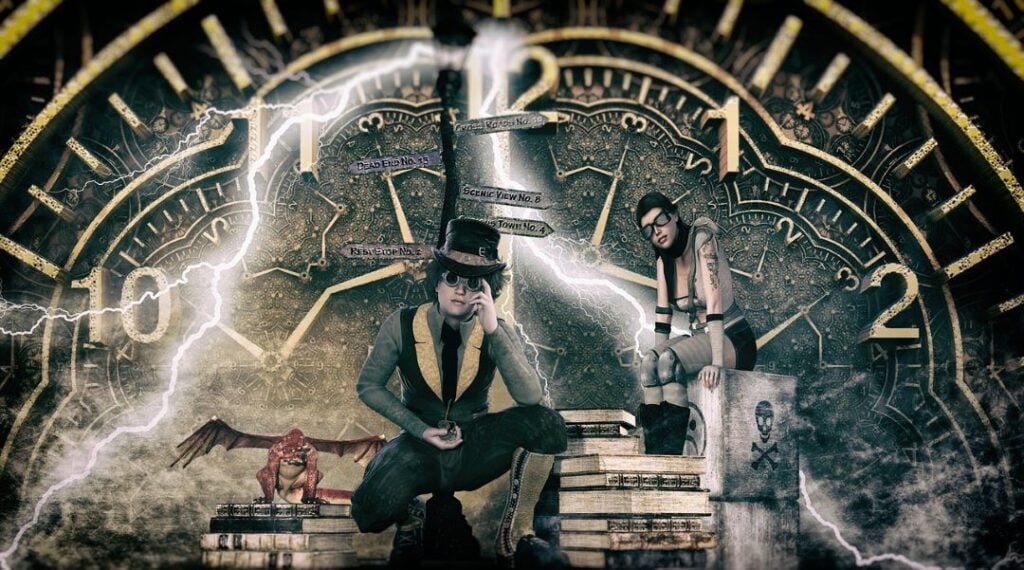
What is steampunk fiction? Discover its key themes, characters, technology, and conflicts, plus tips to write your own steampunk story.
Gas lamps, old-fashioned welding goggles and Victorian period dress – that’s steampunk! This post explains what this literary genre is about and how to write it.
Steampunk, as a literary genre, is relatively new. The term was coined by science fiction author K.W. Jeter in 1987, who tried to find a common denominator for works such as The Anubis Gates by Tim Powers (1983), and his own works, the Morlock Night (1979) and Infernal Gates (1987). Strangely enough, they all took place in Victorian England and had strange similarities to H.G. Wells’s The Time Machine (1895).
Jeter’s term describes a multi-faceted cross-genre phenomenon. It refers to more than literature. Steampunk includes movies (like Wild Wild West starring Will Smith), anime and manga (like The Legend of Korra), as well as all kinds of games and role-playing games (like Victoriana). It is now very much a trend in multimedia.
Let’s look at what it is exactly.
What Is Steampunk?
Take the genres of alternate histories and fantasy. Add a dash of science fiction. Then sieve everything through the flickering light of gas lamps and either a Dystopian or Utopian outlook on life. You end up with the genre of steampunk and its exciting subgenres such as dieselpunk, gaslamp fantasy, and clockpunk. This all falls under speculative fiction.
They all look backwards in time to imagine alternate futures. In a romanticised version of history, the past is seen as a rich material from which our own future was created.
This is an important feature: steampunk looks at the past to create an alternate future. In contrast, science fiction looks at the present to imagine the possible future; the same is true for Utopian or Dystopian literature.
It all began in 1818 with Mary Shelley’s Frankenstein. Technically, this novel is still in the pre-steampunk era, but it laid the foundation for the genre. Together with the novels of H.G. Wells and Jules Verne, science in literature was never quite the same.
Let’s look at some recurring themes.
Recurring Themes In Steampunk
The genre of steampunk literature is very diverse. Sometimes it overlaps with so many other genres that it’s hard to explain why two very different books still belong to the same steampunk genre. However, some recurring themes will help you unmask steampunk stories.
1. Crazy Contraptions
Steampunk loves machines: flying contraptions such as the airship, mechanical robots and clockwork computers, weaponry such as steam-driven cannons and repeating rifles, or submarines.
One of the forefathers of steampunk is Jules Verne (1828-1905). His literary genius envisioned all kinds of technology. He predicted the atomic bomb (The Begum’s Fortune,1879), the submarine (20000 Leagues Under The Sea, 1869), helicopters and aeroplanes (Robur, The Conqueror, 1886), and global communications (Paris in the 20th Century, 1860).
They all belong to the classics of steampunk novels. For example, his submarine, the Nautilus, can do almost anything. It travels at enormous speed, goes to depths beyond the reach of regular 19th-century vessels, and it has destructive ramming capacities. It is powered by electricity!
Steampunk gadgets do come in all shapes and sizes. Gail Carriger wrote a whole series called The Parasol Protectorate (2009-2012) about parasols equipped with all kinds of gizmos, from darts to firearms to chemical deterrents.
2. Energy Sources
Since steampunk is closely linked to the Industrial Revolution, so are its energy sources. Steam, electricity, and air pressure are all important. Even mere mechanics are a recurring theme.
In The Difference Engine (1990) by William Gibson and Bruce Sterling, the authors take us back to the calculating machine by scientist Charles Babbage from 1832. Today, Babbage is known as a precursor of computer science. In real life, his machine never really worked. In the novel, however, the machine is built, running on steam power!
3. Scientists and Explorers
When technology is this important, so are the people building and running it all. The inventor is the steampunk hero, so is the explorer. Both are visionaries that propel the story towards an alternate future.
As so often, madness and genius go side by side. If we look at the 1969 movie adaptation of Jules Verne’s novel, then Captain Nemo is the inventor of the Nautilus (as in the book), but he is also an authoritarian dictator, preventing anyone from leaving his underwater city of ‘Templemeer’.
4. Class and Rebellion
The steampunk universe is not a paradise. While the inventors become heroes, the builders and workers tend to become rebels. In this literary genre, authors not only look at the polished world of the cerebral scientist, but also at the grime involved in making the invention work. The historical period of the Industrial Revolution is portrayed vividly and realistically.
This is why Stephen Hunt’s Steampunk Field Guide places the Guy Ritchie movies about Sherlock Holmes in the steampunk genre. In contrast to the Conan Doyle original, the movie portrays Victorian London not as a gaslamp romance but as an industrial city. It includes menace and danger, and an occult movement that depends on theatre tricks and manipulation – all demasked by Sherlock Holmes, of course.
5. Occultism, Magic, Secret Societies
Let’s not forget that Ouija boards, Theosophic societies, magicians and their parlour tricks also belonged to Victorian society. When steampunk incorporates these elements, it tries to show that there is more to the fictional world than meets the eye. Gaslamp fantasy can drift off quite a bit to include werewolves and vampires (again, see Gail Carriger’s Parasol Protectorate series).
Another classic of the genre is The Anubis Gates by Tim Powers (1983), where the hero is time-travelling through wormholes in the time-continuum. He finds himself stuck in Victorian London. Knowing his modern history books does help him navigate. But it doesn’t save him from experiencing the dangers of the London underworld.
The author uses nineteenth-century Egyptomania to conjure up a deep magical history that seems to work against modern time, complete with an Egyptian sorcerer, deities like Anubis and Osiris, and Egyptian magical concepts like body-swapping. And yet this story is still considered steampunk.
While steampunk is anchored in the machinery of the Victorian age, Gaslamp fantasy emphasises the atmosphere and the mystery of the era.
As you can see, steampunk tends to overlap with other literary genres. If you find it hard to tell them all apart, please consult the Steampunk Field Guide for more examples and a more detailed discussion of the genres.
How To Write Steampunk Fiction
Here are some tips to get you started.
1. Pick An Era And A Location
The tried-and-tested location is Victorian London or turn-of-the-century Europe. You could move beyond this by choosing the Wild West, Tsarist Russia, or Meiji-era Japan.
Pick an era that is in the past, rich with possibilities, and with lots of suggestive symbolism.
2. Include Period Technology With Extended Limitations
Start by choosing your energy source: Steam? Clockwork mechanics? Gas? Electricity?
Then go on and dare to imagine technological gadgets and define their limitations to create conflict. You can also extend their limitations by infusing a dash of fantasy into your story.
3. Address Social Impact
Show how technology defines and changes the daily life of people in your story. What impact does it have on work and social life?
4. Create Exciting Characters
This could be a scientist or an inventor, ingenious enough to create all the technology. Remember to ask if that high IQ also oversees all the downsides of the technology.
Other main characters could be the captain of an airship, or an explorer. Perfect antagonists are working-class rebels who address the friction caused by the class divide or by technology itself. Someone who’s at the workbench producing all those machines and knows that it has a price.
5. Add Core Conflicts
Go back to the age of the Industrial Revolution, and you’ll find many of them right there: man against the machine, nature against the industrial sprawl, the individual against the mechanisation and standardisation.
6. Include Correct Plot Structures
Of course, a good writer can make any plot structure work. However, some lend themselves more easily to steampunk, such as the hero’s journey, or an adventure-driven plotline.
The Last Word
If you like science, but think science fiction is too far in the future, steampunk may be your genre. Its greatest strength is its freedom to mix history, science, fantasy, adventure, and invention in countless ways. You can choose steam-powered machines, explore a dieselpunk world, or travel further back in history with clockpunk. Steampunk gives you the chance to take the past, change the technology, and create a future that could never have existed. Be like the steampunk scientist you write about and invent your own world. You may even invent your own sub-genre.
Image by S Greendragon from Pixabay

By Susanne Bennett. Susanne is a German-American writer who is a journalist by trade and a writer by heart. After years of working at German public radio and an online news portal, she has decided to accept challenges by Deadlines for Writers. Currently she is writing her first novel with them. She is known for overweight purses and carrying a novel everywhere. Follow her on Facebook.
More Posts From Susanne
- How To Write A Space Opera
- What Is Dystopian Fiction & How Do I Write It?
- What Is Utopian Fiction & How Do I Write It?
- How To Write Alternate History: A Complete Guide For Writers
- How To Create Tension In Storytelling
- 7 Benefits Of Keeping A Diary – For Writers
- 7 Gripping Dystopian Plot Ideas For Writers
- Poets On Writing Poetry: Insights & Inspiration
- Poetry Made Easy: How To Read & Interpret Poems
- What Writers Can Learn From Trashy Novels
Top Tip: Sign up for our free daily writing links.