
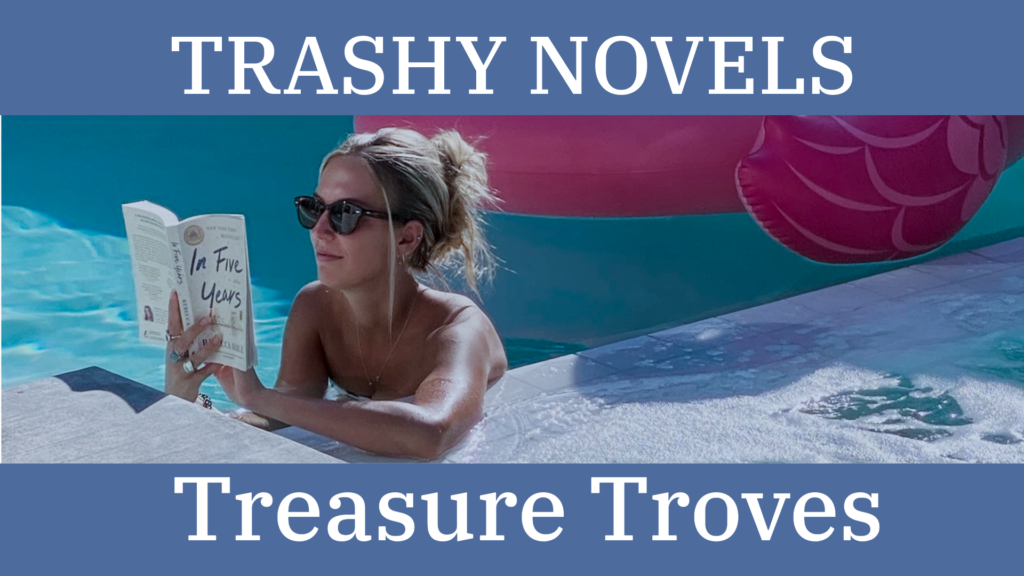
Trashy novels aren’t really trash – they’re lessons in disguise. We explore what writers can learn from so-called ‘trashy’ fiction.
Trashy Novels, Treasure Troves: What Writers Can Steal
Even writers love trashy novels. If they don’t, then they should. Why? Because they have reader numbers every author dreams about. College professors might never discuss them, but these novels certainly are popular!
Trashy novels are guilty pleasures. Hardly anyone confesses to reading them. Most people call them airport novels or beach reads. Originally, they evolved from penny-dreadfuls, or dime novels.
Other names are pot-boilers or pulp fiction. Examples include James Patterson’s, Sidney Sheldon’s, and Danielle Steel‘s novels. Even Charles Dickens’ A Christmas Carol is a famous potboiler! Click here for a list of novelists who belong in this post.
Why are trashy novels so popular in the first place? Let’s take a look.
What Makes Trashy Novels Popular
Most people who confess to reading trashy novels will agree that they are:
- easy to read,
- light enough to carry in any purse,
- give them a satisfactory reading experience,
- have a straightforward plot with clear-cut characters,
- have a clear message,
- and often have follow-ups.
This list already holds all the gold nuggets for writers. You just need to reframe it all from the perspective of an author willing to learn. Here’s how I read it:
The Gold Nuggets of Trashy Novels
1. Style & Diction
Trashy novels are easy to read. No flowery phrases, no complicated metaphors, no excess similes. If there’s a symbol, it’ll be easy to decipher. The authors use everyday syntax, without too many subordinate clauses. The sentences themselves are short and mostly written in the active voice.
The author of a trashy novel also uses everyday vocabulary. If there is a shift in register, then it’ll be very natural. Allusions will be easy to pick up.
What’s ‘easy to read’ is also ‘accessible’. Trashy novels want readers to focus on the unfolding story rather than be held back by style or diction.
Writers who write like this maximise the number of their potential readers.
2. Weight & Length
Trashy novels usually aren’t very long (a typical Patterson novel is about 70,000 words!). The physical books aren’t heavy. Usually, they’re sold as paperbacks or even as e-books nowadays. That has several advantages.
Lightweight books can be carried anywhere. You can read them on the train to work. You can take them along on your lunch break. You can even read them in bed, where a heavy tome resting on your chest would seriously impair your breathing. Low weight means your reader is less likely to put the book down.
There are, however, exceptions to the rule. For example, E.L. James’s Fifty Shades of Grey, often called ‘trashy’, is at least 600 pages (depending on the edition). And yet this book has sold over 150 million copies worldwide. Why is it so successful? Because this novel hit a nerve. And it satisfied its readers in more than one sense.
3. Reader Satisfaction
When are readers totally satisfied with a book? That’s hard to answer. We know that reading works better if the readers experience a certain momentum. How does that work? You need an exciting story (we’ll get to that one later). That’s hard to achieve. And you need to let the reader complete shorter units.
Short units mean everything: sentence length, the length of a paragraph, the length of a chapter, the length of a novel. Shortness creates speedy reading. Shortness creates reader satisfaction.
Here’s the hitch. Your sentences, paragraphs, and chapters still need to vary in length. Otherwise, your reader will think your story is just a sequence of commands (that’s not satisfying at all).
Creative writing teachers will tell you that shortness is a pacing tool. It is! It is also a way to make your reader come back for more.
4. Plot And Characters
Since trashy novels are short, they can’t waste time on a plot structure that’s too intricate or a cast of characters where everybody has a complicated background story.
No, the inciting moment must come quickly. The sequence of events then must whirl you away right till the end. This doesn’t mean that the plot must be predictable. It’s just that the author doesn’t have time to deviate from the plotline. There are no detours, no excursions.
Everything the author writes must contribute to achieving the end. This can make the plot formulaic, or even predictable.
Trashy novels teach writers how to achieve their story goal.
The cast of characters must help with that. Each character must have a clear reason to exist in the story. That’s not easy at all.
Think about your own stories: how many unimportant people have you given names? For example, if there’s a barista serving coffee, why do you mention that he’s called ‘Brad’? How many unimportant people do your main characters suddenly tell stories about their vacation?
Trashy novels have a small cast of characters where each has a clear function in the story.
5. Clear Message
Every story has a message. It can be as simple as ‘Good guys win over the bad guys.’ It can also be very complicated if you don’t really know if the good guys really are all good. If the ending is unclear, if considerable doubt remains, the reader is left with an unclear message. Trashy novels never do that.
The moral world of a trashy novel is clear. The rules of the fictional world are clear. The trashy novel never leaves the reader in doubt.
6. Story Formula
A popular trashy novel will come in a series. The original story will be recognisable in each new part. New readers must be able to access the story at any given point. Background will be hinted at wherever you need it. But then, there isn’t that much background anyway.
Never change a winning team – and authors of trashy novels won’t do that ever. Trashy novels teach us that successful formulas should be varied but never changed.
The Last Word
Trashy novels tend to like certain genres: thrillers, police procedurals, crime fiction, cozy fiction, category romance, historical romance, and family sagas. Their grip on readers is admirable. The most important lesson writers can learn from trashy novels is how to hold readers’ attention. That’s no small feat and not trashy at all.
Source for image: Dupe

By Susanne Bennett. Susanne is a German-American writer who is a journalist by trade and a writer by heart. After years of working at German public radio and an online news portal, she has decided to accept challenges by Deadlines for Writers. Currently she is writing her first novel with them. She is known for overweight purses and carrying a novel everywhere. Follow her on Facebook.
More Posts From Susanne:
- 10 Weird Things Writers Do
- Weird Habits Of Famous Writers
- What Is Blackout Poetry & How Do I Write It?
- 6 Lessons From Lord Byron – How To Make Others Swoon With Words
- How To Write A Cozy Mystery
- The Writers Write Book Reading Challenge – 3
- 20 Weird Things Readers Do
- The 5 Most Common Themes In Literature
- What’s A Golden Shovel Poem? & How Do I Write One?
- How Your Writing Tool Shapes Your Text
Top Tip: Sign up for our free daily writing links.