

Intimidated by poetry? Learn simple, effective techniques to read, understand, and enjoy poetry with confidence, even if you’re a beginner.
How To Read Poetry
So, you think you know how to read? Well, a poem will put your reading skills to the test. It’s because a poem involves so much more than just reading. It involves letting the poet’s ideas (packaged in the poem) pass through your mind and soul. It does take courage on the reader’s side! But it’s worth it. It’s also easy – if you know the three laws of reading poetry.
The Three Laws Of Reading Poetry
First Law Of Reading Poetry: Everyone can do it. Let the poem happen.
Truly, everyone can appreciate poetry. The thing is – we all do it differently. Every poet knows that. But readers of poetry often don’t. That’s why this blog aims to encourage you! Please bear in mind that poets are people, too. They can only create to the best of their abilities. They write a poem, but then, they have to let it go. Because once the poem is read, it evolves into another poem – inside the reader. The poem meets a personality with a life, with a past, and a cultural background that may be very diverse from the poet’s. And every poet knows that.
Second Law Of Reading Poetry: Let the poem pass through you. Open up for poetry.
Let the poet’s creation meet with every aspect of you. No academic degree needed. Then watch what happens. By the way, it is totally normal that not every poem speaks to you. Just try another one. If you still find reading poetry difficult, try to appreciate the poem with your senses.
Third Law of Reading Poetry: A poem is a sensual experience.
A poem is a complete work of art that appeals to all your senses. It’s not just a text! Don’t believe me? Let’s go through this with some examples. We’ll work our way from the outside in.
1. How To See A Poem
This may seem ridiculous at first. After all, a poem is not a painting – or is it?
Most poets choose to write a poem as a text. If it’s a solid block of text, then those poems are called prose poems. Prose poems do not appeal to your eyes. Their charm lies in the other senses.
All other poems are structured in lines and stanzas. The number of lines often says something about the poetic form. The most famous example is the sonnet, which always has 14 lines.
The white space between each stanza gives our minds a little break before the poem continues. Stanzas are a way of structuring the poem’s content. They’re also a pacing tool.
Some poems make more use of the way they appeal to the eye. Usually, these poems are called ‘concrete poetry.’ These are poems that are written in such a way that the words form a shape. That shape can underline the poem’s message or contradict it.
Here’s an example from George Herbert. It’s called ‘Easter Wings’ (1633):
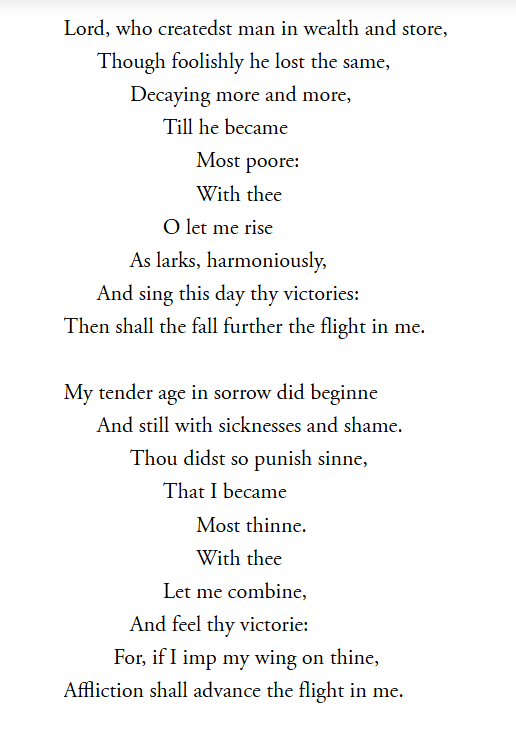
Image source: Poetry Foundation
Can you see how the stanzas look a bit like the wings of a bird? Here, what we see underlines the poem’s message (more about this poem later).
Poets can take the creation of images one step further. They can create a poem as a piece of visual art. This is called ‘visual poetry.’ Here’s an example from Lidia Chiarelli.
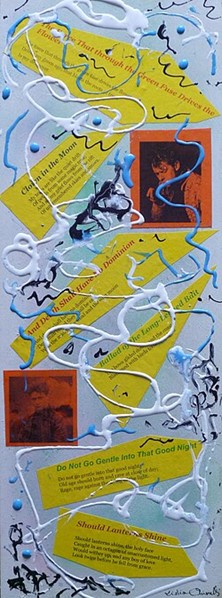
Image source: Lidia Chiarelli, CC BY-SA 3.0 via Wikimedia Commons
Top Tip: Ask yourself: When I look at the poem, what shapes do I see? Do they remind me of anything? Does the look of the poem already have a certain meaning to me?
2. How To Feel A Poem
‘Feeling’ a poem has to do with the material on which the poem is written or constructed. This aspect is often overlooked.
Clearly, Lidia Chiarelli’s poem was created on canvas. It’s a collage made of mixed media (canvas, acrylic paint, pieces of paper). Canvas feels different from paper, and a book feels different from the internet. The material gives the reader a different sensation.
George Herbert’s poem points us in another direction. Originally, it was printed in a book, yes. But because of its shape, it didn’t fit on one page, so the publisher printed it sideways. Readers had to turn the book around to read it. I didn’t do that here for convenience’s sake. Turning the book around is also a sensation!
Top Tip: Look at a poem, touch it, and then close your eyes. You might even want to smell it. When does a poem feel like a true poem for you? Would Lidia Chiarelli’s poem feel more like a painting or a poem? Can you smell the acrylic paint? What do these sensations evoke in you?
3. How To Hear A Poem
Most readers are taught to read a poem and then rush to interpret it. That’s the analytic part of the brain kicking in. But the ear is needed before the brain!
Please read George Herbert’s poem again. It’s important to read it aloud. Can you hear the end rhymes of ‘store/more/poor’? And ‘same/became’? The other part of the first stanza rhymes on a different sound: ‘thee/harmoniously/victories/me’.
The [ore]-sound is a dark vowel sound. To me, it’s as if the bird is flying downward. The [ame]-sound is actually a blend of [a] and [i]. These are sounds that open up. After that, we have the lighter vowel sounds, the [ee]-sound.
Just listening to the end rhymes, I can hear this: the poem oscillates between dark and light sounds, mimicking the bird rising and falling.
Top Tip: Always read a poem out loud. Read it in different voices, even at different speeds. What do you feel? What’s the atmosphere of the poem? Cheerful? Sinister? Funny?
If you’re interested in the sounds of poetry, then please read this series of blogs on poetic sound effects.
4. How To Understand A Poem
This is what most teachers try to teach in school. It’s also where most readers think they are at a loss.
Teachers tell students about literary terms like metaphors and similes, about symbols, and about all the background information you can unearth in a library about the poet. Let me assure you: no poet ever writes a poem to require readers to have a PhD in literary sciences.
Of course, all that academic information helps to unlock the meaning of the poem. But a poem has many levels of meaning. And the only important level is the one resonating with you, the reader. Scholarship is great, but a personal appeal to the reader is better.
Let’s look at George Herbert’s poem again. I find the theme of the bird going up and down to be the most important element. The bird is a lark, which sings early in the morning. So, right after the night’s darkest hour (or after Jesus’ death), there is a creature that makes music! This music lets us take flight and rise above our earthly afflictions. In this sense, Jesus is like that bird. He, too, let us rise beyond our human restrictions.
This is my personal interpretation. Scholars might agree, or they might not. But that poem stirred something in me.
Top Tip: Don’t let scholars intimidate you. Read the poem and see what meaning you can discover for yourself. Don’t be afraid to find your personal interpretation. It’s the only one that matters to you.
The Message
Maybe this is the most important message: don’t let anyone intimidate you when it comes to reading poetry. Poetry can offer a world much too beautiful to discard. A poem is much more than just a text. What it truly is depends on you, the reader. You need to let it happen. The true poem is inside you. Enjoy.
The Last Word
You do not need to be afraid. With the right approach, anyone can learn how to read, interpret, and enjoy poetry. Take your time, stay curious, and don’t be afraid to explore different meanings. Poetry is meant to be experienced, not solved.
Recommended reading: Billy Collins’s 6 Pleasures Of Poetry

By Susanne Bennett. Susanne is a German-American writer who is a journalist by trade and a writer by heart. After years of working at German public radio and an online news portal, she has decided to accept challenges by Deadlines for Writers. Currently she is writing her first novel with them. She is known for overweight purses and carrying a novel everywhere. Follow her on Facebook.
- What Writers Can Learn From Trashy Novels
- 10 Weird Things Writers Do
- Weird Habits Of Famous Writers
- What Is Blackout Poetry & How Do I Write It?
- 6 Lessons From Lord Byron – How To Make Others Swoon With Words
- How To Write A Cozy Mystery
- The Writers Write Book Reading Challenge – 3
- 20 Weird Things Readers Do
- The 5 Most Common Themes In Literature
- What’s A Golden Shovel Poem? & How Do I Write One?
Top Tip: Sign up for our free daily writing links.
2 thoughts on “Poetry Made Easy: How To Read & Interpret Poems”
Thank you! Your article encouraged me to give poetry a try.
Hi Raymond! Thank you so much. That my article convinced you to try – well, that‘s the greatest compliment. I hope you have lots of fun!
Comments are closed.