
Creative writing teachers say writers should keep a diary. So, why don’t we? Maybe because we don’t see the point? Or because we don’t know how? This blog is here to help, because keeping a diary does matter.
We all know what a diary is, don’t we? It involves taking one of those cute notebooks we hoard for dire times, and we just haven’t been able to start. Sound familiar? This was me – until I thought hard about what a diary truly was, and what it could be for me. Let me convince you.
What Exactly Is A Diary?
The question sounds superfluous, I know. Please hear me out. According to Wikipedia, a diary is first and foremost a record of events arranged by date. Traditionally, it is written by hand, but nowadays, it exists in digital form, either on a cell phone or a computer.
Diaries can also be an audiovisual recording, either as a voice message or as a video. Since we’re all writers, I’ll concentrate on the written diaries.
There are different approaches, and they all have an impact on what the diary (or journal) can do for you. But first, let’s look at what keeping a diary can do for you as a writer.
7 Benefits Of Keeping A Diary – For Writers
Ever wondered what journaling can do for you as a writer?
1. Encourage you to write.
A diary is the perfect training ground for writers. There’s no formal restriction, no hierarchy of topics, no censorship, no editing. Just you and your pen (or computer, but we’ll get to that later). Let the words flow!
2. Promote a writing habit.
This is key to being a writer. You need to create a habit, or writing will just be a ‘once in a blue moon’ hobby. Of course, that habit needs to suit you. If it doesn’t fit into your lifestyle, you’ll quit (as many people do). Here are two key points to consider:
- You don’t need to write every day.
- You don’t need to write a set number of lines or for a set amount of time.
You get to decide. You can write one line per day. Or you’ll write five pages at the end of the week. But you need to form a habit. Why? Because if you’re used to forming thoughts into sentences, then words will flow easily when you sit down to write a story. The habit of keeping a diary will make you a better writer.
3. Sharpen your focus.
As you engage with your diary, you are alone with your brain. You shouldn’t let anyone or anything disturb you. Not even your inner critic!
This is your Me-Time. That will show the writer inside you that whatever you pour onto a page – it’s ok! Your words deserve the space.
This will build the self-confidence you need for writing poems and stories. You need to write that first draft without the fear of the inner critic.
4. Help you get unstuck.
Very often, our thoughts are so noisy that we keep going over the same things again and again. It’s like a vicious circle. It’s also one of the reasons for procrastination.
Diaries are a possible remedy. Try a brain dump. By unloading all the noisy thoughts onto the page, you clear your mind. That clarity really helps you get unstuck. It can certainly help overthinkers!
5. Let you sort your thoughts.
Many people list the pros and cons to decide. A diary does the same thing. It works even when the categories of ‘pro and con’ don’t really apply. Writing in your diary, you will argue with yourself, going through possibilities, back and forth, until you get to the point when you know what to do.
This also works for problems in your writing. Go through possible scene ideas, work them out, and just see what works best.
6. Let you explore your personality.
A diary isn’t edited. No need to mince your words! Where else can you explore different sides of your personality? Or different writing styles? You could try out different versions of yourself, and no one will ever know.
For your literary self, it’s important that you do. This is a great way to find your own style.
7. Record your life.
Now this really depends on how you do this. If you just write ‘this happened, and then this happened, and then this’ – well, that’s just an itinerary, right? About as boring as a train schedule.
It’ll get much more interesting if you record events and the feelings they provoke. What about your experiences and the lessons you draw from them? Places you visit, people you meet, and how they impressed you?
Do this, and your diary becomes a treasure chest where you keep all the gems of your life. This can come in handy for you as a writer – your diary will be a literary notebook! You’ll never run out of ideas.
Now that these benefits have convinced you to keep a diary, you need to decide on two more things. They’re technical but important.
The Medium Is Part Of The Message
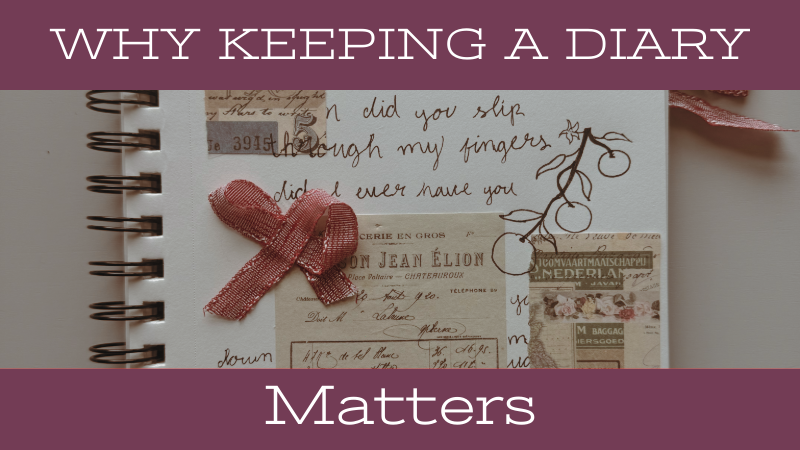
First and foremost, your diary is exactly that – your diary. So be brave and make it into whatever you want. If you are a writer who also illustrates, or simply likes to include visuals in your writing, do just that. Include little doodles, bits from a newspaper, pictures, sketches, or drawings. Make it a scrapbook.
Other than that, writers have two options: either write by hand or keep a digital version on a computer or a cell phone.
The benefits of writing by hand have been discussed widely (you can read up on them here), and they all apply to keeping a diary. Writing by hand is good for your body, and it tends to result in better writing. What you practice with your diary will prepare you for writing creatively.
Yet some people choose to write with a computer. This can be due to a physical condition. It can also be a deliberate choice. Writing with a keyboard does give a certain free rein to your inner critic. However, it’s also a very fast way of writing for many people. Fast writing, especially if it’s close to automatic writing, silences the inner critic and gives your brain free access to the page.
The Best Time To Write
Night journaling is the traditional way of keeping a diary. At the end of the day, you look back and assess your wins and your struggles. This will produce some sort of reckoning. At some point, you’ll say if it’s been a good or a bad day for you. That sounds a lot like the ugly twin of the inner critic, doesn’t it? This is the danger of night journaling. Please be aware of that. Try to write without judging. No editing, remember?
Yet the evening gives you plenty to write about. If you can include gratitude in your diary writing practice, then this will also help you get out of the reckoning mode. Gratitude lets you assess a situation, and then it takes you into the future by thinking about what you have (rather than what you lack).
Morning diaries tend to be future-oriented by nature. This is why Julia Cameron chose the ‘morning pages’ as her technique to enhance creativity. There is a slight difference between the two.
A morning diary simply means that you sit down to write, not reflecting on the day past, but the day ahead. This kind of diary tends to be more optimistic. It’s all about plans and hopes and dreams. Morning diaries are about what could be. This can put you into a more creative mood. However, the blank page can also leave you without anything to write about. In this case, try doing this with a prompt (Writers Write has lots, here’s the link).
The ‘morning pages’ try to channel the morning diary into something more literary. Julia Cameron wants you to write for either 20 minutes or to write 3 pages, uninterrupted, unedited, just free writing. Chances are, you’ll discover an idea worth exploring further in your creative writing.
Some people find this hard – sometimes we need a good brain dump in our diary to quiet those noisy thoughts. Only then will creativity rise. Why not try Julia Cameron’s technique in the evening? Who says ‘night pages’ can’t work for you?
The Last Word
Writing is good for you – any kind of writing. The more you do it, the more you build your writing muscle. A diary is the easiest way to do it.
This little book will also serve you as a record of settings. Whenever you sit in a café, whenever you travel to another city or even country, when you’re at someone else’s home – whatever you see, and whatever impresses you, write about it. It’s this kind of information that fuels our stories with lots of ‘showing.’
The biggest benefit of a diary is a psychological one. It clears your mind, and that gets you unstuck. It helps you to create the comfort zone you need to write.
Start a diary today. Happy writing!

By Susanne Bennett. Susanne is a German-American writer who is a journalist by trade and a writer by heart. After years of working at German public radio and an online news portal, she has decided to accept challenges by Deadlines for Writers. Currently she is writing her first novel with them. She is known for overweight purses and carrying a novel everywhere. Follow her on Facebook.
More Posts From Susanne:
- 7 Gripping Dystopian Plot Ideas For Writers
- Poets On Writing Poetry: Insights & Inspiration
- Poetry Made Easy: How To Read & Interpret Poems
- What Writers Can Learn From Trashy Novels
- 10 Weird Things Writers Do
- Weird Habits Of Famous Writers
- What Is Blackout Poetry & How Do I Write It?
- 6 Lessons From Lord Byron – How To Make Others Swoon With Words
- How To Write A Cozy Mystery
- The Writers Write Book Reading Challenge – 3
Top Tip: Sign up for our free daily writing links.