

This post is about why revenge is a brilliant plot for beginner writers. Revenge builds a framework for a story with a beginning, a middle, and an end.
If you’re looking for a plot for a first novel, we always recommend revenge.
Why Revenge Is Such A Brilliant Plot For Beginner Writers
- It works in every genre.
- It helps beginner writers focus on a story goal.
- It requires an antagonist – something most beginners ignore.
If a character wants revenge it usually means that he or she is motivated to act. This is good. Reactionary characters are not interesting to readers, and they usually can’t drive a plot. It also means that something interesting has happened and that more interesting things are likely to happen.
Revenge also builds a framework or plot for a story with a beginning, a middle, and an end.
Examples of Stories of Revenge:
- The Count of Monte Cristo by Alexandre Dumas (Adventure)
- The Princess Bride by William Goldman (Fantasy)
- Hamlet by William Shakespeare (Revenge Tragedy)
- Carrie
by Stephen King (Horror)
- The Girl Who Kicked the Hornet’s Nest by Stieg Larsson (Psychological Thriller)
- The Iliad by Homer (Epic Poetry)
- The First Wives Club by Olivia Goldsmith (Women’s fiction sub-genre Chick-Lit)
- Gone Girl by Gillian Flynn (Thriller)
- Wuthering Heights by Emily Brontë (Gothic Romance)
- Crime and Punishment by Fyodor Dostoevsky (Literary)
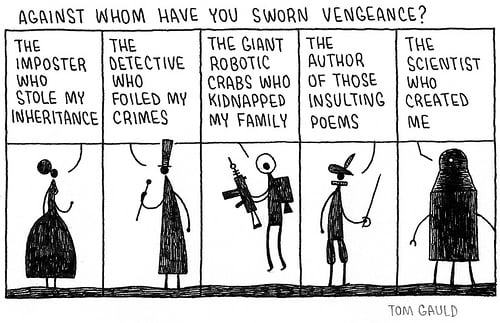
Consider this…
Because the hero’s quest for revenge often goes outside the limits of the law, you have to manipulate the feelings of the reader by letting the hero avenge an injustice. If you want your reader to empathise with a protagonist who seeks revenge, remember these three points:
- Your protagonist should be morally justified to seek revenge. They should have tried traditional, lawful channels before they resorts to vigilante tactics.
- Show how the antagonist has destroyed the protagonist’s life in emotional and physical ways.
- Your protagonist should remember that the punishment must fit the crime. Don’t let them go overboard and become an evil creature whose behaviour is worse than the antagonist’s.
Whether the protagonist succeeds or fails, the reader should feel better that he or she has at least tried to do something about the situation. This is cathartic for readers who often feel powerless in similar situations.
The Last Word
Read more about revenge here: A Quick Start Guide To Writing Revenge

by Amanda Patterson
© Amanda Patterson
Read more on plotting here:
- The Top 10 Tips For Plotting And Finishing Your Book
- The One Thing You Need To Know About Plotting A Series
- Plot Builder – 3 Steps To Sparking A Satisfying Story
- What Is A Plot? – A Writer’s Resource
- The Secret To Writing A Great Plot Twist
Top Tip: Find out more about our workbooks and online courses in our shop.
3 thoughts on “Why Revenge Is Such A Brilliant Plot For Beginner Writers”
Thank you so much Amanda. I needed this.
Thank you!
gave substantial help for first screenplay draft
Comments are closed.