
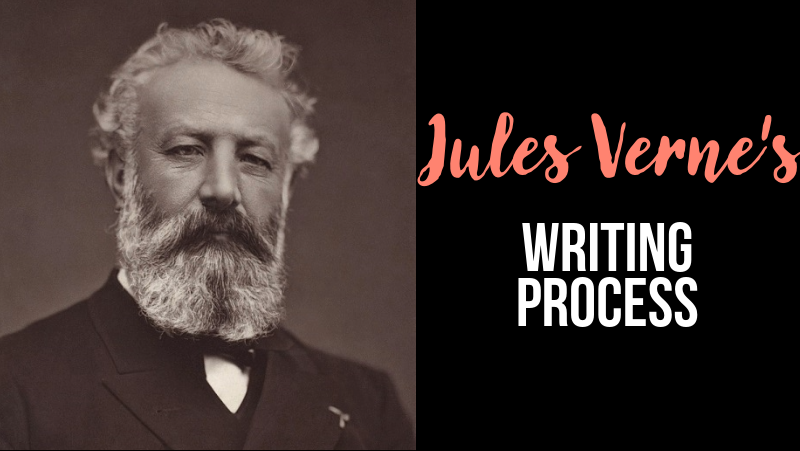
We’re writing about the acclaimed science fiction writer, Jules Verne. In this post, we explore Jules Verne’s writing process.
Jules Verne was born on 8 February 1828 and died on 24 March 1905. He was a prolific French speculative fiction author who is often called the father of science fiction.
His best known novels are Twenty Thousand Leagues Under The Sea, Journey to the Centre of the Earth, and Around the World in 80 Days
Verne never studied science but said: ‘But while I was quite a lad I used to adore watching machines at work. My father had a country-house at Chantenay, at the mouth of the Loire, and near there is the government machine factory of Indret. I never went to Chantenay without entering the factory, and standing for hours together watching the machines at work.’
Jules Verne is the second most-translated author in the world since 1979, below Agatha Christie, and above William Shakespeare. His works have been translated into more than 140 languages.
His stories have has inspired generations of writers and scientists, inventors, and explorers.
In this post, I am taking a look at Jules Verne’s writing routine and writing process.
Jules Verne’s Writing Process
- I rise every morning before five—a little later, perhaps, in the winter—and at five a.m. I am at my desk, remaining at work until eleven. I have made a point of doing three hours’ writing before breakfast. The great bulk of my work was always done in this time, and though I would sit down for a couple of hours later in the day, my stories have really nearly all been written when most folks are sleeping.
- I start by making a draft of what is going to be my new story. I never begin a book without knowing what the beginning, the middle, and the end will be.
- After having completed my preliminary draft, I draw up a plan of the chapters, and then begin the actual writing of the first rough copy in pencil, leaving a half-page margin for corrections and emendations; I then read the whole, and go over all I have already done in ink.
- I consider that my real labour begins with my first set of proofs, for I not only correct something in every sentence, but I rewrite whole chapters. I do not seem to have a grip of my subject till I see my ‘work in print’; fortunately, my kind publisher allows me every latitude as regards corrections, and I often have as many as eight or nine revises. I envy, but do not attempt to emulate, the example of those who from the Chapter I to the word Finis, never see reason to alter or add a single word.
- Thanks to my habits of regularity, I invariably produce two completed novels a year. I am also always in advance of my work; I usually have five manuscripts ready for the printers. Of course, this has not been achieved without sacrifice. I soon found real hard work and a constant, steady rate of production incompatible with the pleasures of society.
- I work very slowly and with the greatest care, writing and rewriting until each sentence takes the form that I desire. I have always at least ten novels in my head in advance, subjects and plots already thought out.
Source for Verne’s writing processes: Jules Verne interview with Jean-Marc Lofficier
Source for Image Public Domain
https://en.wikipedia.org/wiki/File:Jules_Verne_by_%C3%89tienne_Carjat.jpg

If you enjoyed this post, you will love:
- Anton Chekhov’s 6 Rules For Writing Fiction
- Edith Wharton On Writing Fiction
- Elizabeth Strout’s Writing Process
- Harlan Coben On Writing Suspense
- Brandon Sanderson’s 3 Rules For Magic
- 10 Bits Of Writing Advice From Colson Whitehead
- 9 Bits Of Writing Advice From Naomi Alderman
- 9 Bits Of Writing Advice From Guillermo del Toro
- Douglas Adams On The Difficulties Of Writing
- Writing Advice From The World’s Most Famous Authors
Top Tip: Find out more about our workbooks and online courses in our shop.