
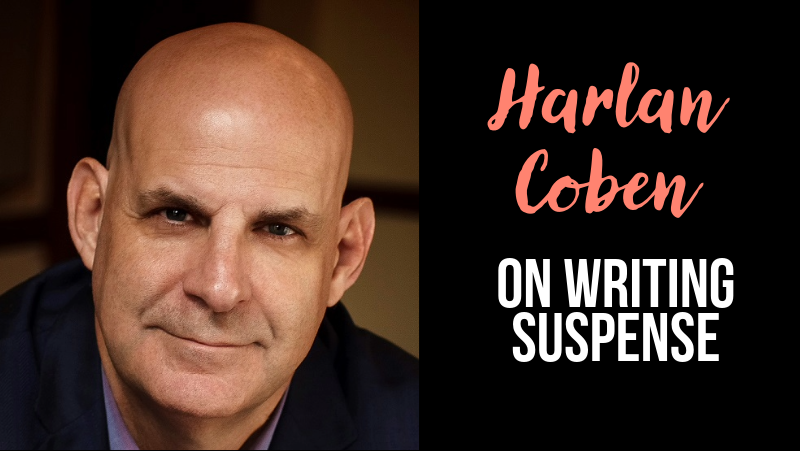
We’re writing about the bestselling thriller author, Harlan Coben. In this post, we feature Harlan Coben on writing suspense.
Harlan Coben was born on the 4th of January 1962.
He is an American author of mystery novels and thrillers. Coben has written 35 novels and has 90 million books in print. His books are published in 46 languages around the globe. He is also the creator and executive producer of global hit TV shows including Fool Me Once, The Stranger, Missing You, Run Away, and Lazarus, with many more in the works.
Harlan Coben has mastered the art of keeping people turning the page or keeping them glued to the screen. We can’t wait to see what happens next.
The author has a perfect formula that combines thrilling suspense with everyday life made extraordinary. A typical Harlan Coben novel has a seemingly idyllic suburban backdrop, a relentlessly gripping storyline with a number of suspects, and plot twists and endings you never see coming. His characters are usually ordinary people protecting who and what they love.
In this post, we’re sharing quotes from Harlan Coben on writing suspense and plot twists.
Harlan Coben On Writing Suspense
- ‘Elmore Leonard says, ‘I try to cut out all the parts you’d normally skip.’ That may be the best piece of writing advice given by anybody ever. I don’t write that way just the first pages. I try writing that way the whole time. I really try to grab you on the first sentence and hold your attention all the way through. It doesn’t slow down after those first pages. It may even pick up steam. Especially towards the end, you’re just whipping through the pages. That’s what I hope to do.’ (Pop Culture Classics)
- ‘Character-building is an organic process for me. It just sort of happens. I kind of come up with an idea and I wonder who’s going to tell it. And that character emerges.’ (Pop Culture Classics)
- ‘Nothing about the process is much fun. There’s an old saying, ‘I don’t like writing… I like having written.’ I think that applies to me. I work pretty hard on the twists. I take a great deal of pride in making sure that, even in today’s world, where you’ve seen every kind of twist, you still are going to be fooled by what happened and who did it’ (Pop Culture Classics)
- ‘By now, I can sort of see and make sure I don’t go in the direction that’s expected. Or I’ll occasionally go in a direction that’s expected, because that’s unexpected. But it’s nothing you can force. Usually the characters have to take you there. And similar to the character development, it’s also an organic process. There are times I’ll think of a twist way ahead of time, but, by the time I get there, that twist just feels like a twist, it doesn’t feel like a reasonable outcome of what’s been going on.’ (Pop Culture Classics)
- ‘Some people would actually classify [my books] more as love stories than thriller. I like that combination. A writer can make your pulse pound with a fast-moving plot, but if you don’t really care about the characters, if you aren’t really interested in what’s at stake for them, it’s not going to work. And what’s a greater sort of thing than a possible lost love?’ (Pop Culture Classics)
- ‘I’m very big on loss, very big on redemption. I’m big on missing people. Big on friendship. I’m big on family. This one is also about identity and our identity of ourselves, what secrets and lies we all keep, from ourselves and from others.’ (Pop Culture Classics)
- ‘I guess to the public, the mystery has more of an Agatha Christie, locked-door, solving-the-case connotation, while a thriller is more action-packed. In both cases—and really in the case of any writing, I think—it should more be about suspense, about making people want to read the next word, the next sentence, the next paragraph and the next page, and I think probably thriller is the purest form of that.’ (Writer’s Digest)
- ‘I want it to be compulsive reading. So on every page, every paragraph, every sentence, every word, I ask myself, “Is this compelling? Is this gripping? Is this moving the story forward?” And if it’s not, I have to find a way to change it. It doesn’t mean you can’t have the larger issues, or setting or descriptions, but even those have to be done in a way that is compelling. No word should be wasted.’ (Writer’s Digest)
- ‘It’s really more interesting, I think, to write about gray characters than it is to write about black and white. Even the so-called villain: How bad was he or she? I prefer it to be the kind of evil you could almost see yourself doing if you were put in that circumstance.’ (Writer’s Digest)
- ‘And I love the twist. I love to fool you once, I love to fool you twice, and on the very last page, quite often—very last paragraph sometimes—I like to just play with your perception one more time in a way that makes everything that came before just a little bit different. I love when that happens to me as a reader, so I love to do it as a writer.’ (Writer’s Digest)
- ‘None of my books are ever just about thrills, or it won’t work. You can have the most expensive car in the world, but if there’s no gasoline, it’s not going to go anyplace. So there is usually a theme, and you do need that character that people care about, that’s real to them. Otherwise, I could give you the greatest twist in the world, but if you don’t care about the characters, you’re not going to follow it.’ (Writer’s Digest)
- ‘I do think it helps to know the ending—that final twist that I hope you find gut-wrenching and shocking—before I start. Then it becomes more a question of telling your story and letting the narrative work organically.’ (Crime Reads)
- ‘I think it’s more compelling to write about people more like you and me, people who are trying to do right but wrong still seems to find them.’ (Crime Reads)
Follow Harlan Coben on Bluesky, Facebook, and Instagram.
Source for image: Author’s Press Room

If you enjoyed this post, you will love:
- Brandon Sanderson’s 3 Rules For Magic
- 10 Bits Of Writing Advice From Colson Whitehead
- 9 Bits Of Writing Advice From Naomi Alderman
- 9 Bits Of Writing Advice From Guillermo del Toro
- Douglas Adams On The Difficulties Of Writing
- 6 Bits Of Writing Advice From Richard Osman
- 5 Bits Of Writing Advice From Kathy Reichs
- Jennifer McMahon’s Top Writing Tips
- 5 Bits Of Writing Advice From Arthur Hailey
- Writing Advice From The World’s Most Famous Authors
Top Tip: Find out more about our workbooks and online courses in our shop.