
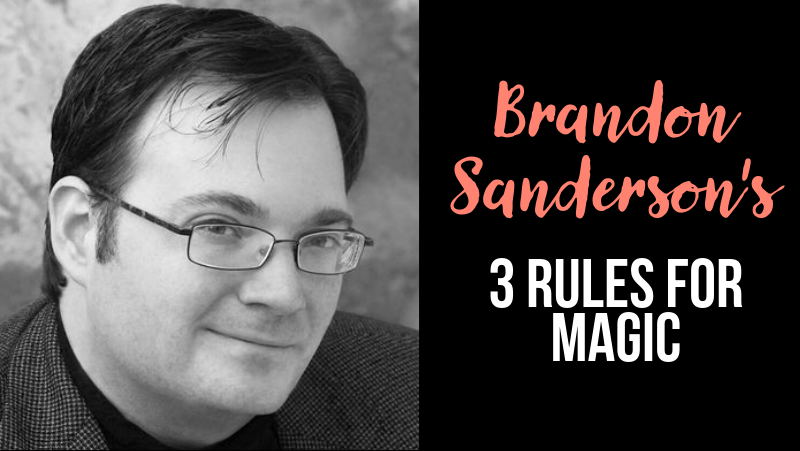
Building worlds requires structure, and 3 magic rules – at least according to Brandon Sanderson. In this post, we feature Brandon Sanderson’s 3 Rules For Magic.
Brandon Sanderson was born 19 December 1975. He is an American fantasy and science fiction writer. He is best known for creating the Cosmere universe, in which most of his fantasy novels are set, including The Mistborn series. The trilogy consists of The Final Empire, The Well of Ascension, and The Hero of Ages. The series is a hybrid epic fantasy heist story with a focus on political intrigue and powerful action scenes.
Sanderson also rose to prominence in 2007 when he was chosen to complete the final books in Robert Jordan‘s epic fantasy series The Wheel of Time after Jordan’s death.
Sanderson’s books have been nominated for, and won, numerous awards. He had written many novels – 71 books as of 2023 and he has sold 50 million copies of them.
[Visit his website and follow him on Facebook.]
He also has three rules he follows to set up his world’s magic systems. But, before that, he tells us that there are two types of magic.
Two Types Of Magic
1. Soft Magic
Soft magic is where the author is just making up rules as they go along. Or rather, these are stories where the magic is not explained to the audience.
The Lord of the Rings could fit this description. We often see magic used in The Lord of the Rings, but there is no obvious source or method to it.
For instance, the Dwarves put wards and curses on the treasure they take from the trolls in The Hobbit but we are not told how they do it or what these spells even do.
Gandalf uses magic to make light and shoot thunderbolts at goblins; he makes colourful smoke rings and magic runes on stones, but we never are told what his limits and restrictions are.
2. Hard Magic
Hard magic is when an author states explicitly what the rules are and how they work. They give the audience all the tools to assess what is done with magic and what it is possible to do with this magic.
The best examples are the Dungeons and Dragons books. These books are based on a game with thousands of rules for magic. The audience can read these rules for themselves. So it is obvious when an author is cheating the system. It does not happen very often, and if it does, it is often intentionally disrupting.
Sanderson argues that somewhere in between these two is the sweet spot. He leans more on the rules based side, but says each can clearly work.
[Read: Hard Or Soft Worldbuilding: Which Is Right For You?]
Brandon Sanderson’s 3 Rules For Magic
Sanderson’s Rules For Magic (You can find these on his blog)
The First Law
“Sanderson’s First Law of Magics: An author’s ability to solve conflict with magic is DIRECTLY PROPORTIONAL to how well the reader understands said magic.” ~Brandon Sanderson
Example:
- Firstly, I don’t know what Gandalf can do, thus he could do anything. Therefore, we can see that Gandalf’s soft magic is potentially infinity powerful.
- Conversely, I know X wizard can only cast 4th level spells, so I know they could cast fly to get out of danger. So the hard limits of rules based spells stop the author from exploiting magic to solve every issue.
The Second Law
“Sanderson’s Second Law can be written very simply. It goes like this: Limitations > Powers
(Or, if you want to write it in clever electrical notation, you could say it this way: Ω > | though that would probably drive a scientist crazy.)” ~Brandon Sanderson
Basically, he argues that Struggle, Tension, and Depth are needed for a good story.
And, it is difficult to create tension when the hero can do anything.
So, let us say the Wizard in The Mighty Nein is a very accomplished wizard and can solve all his problems with magic. But magic requires magic components to cast spells, and he has lost those. This gives him depth, a purpose, and something to struggle with, or at least for.
On the other hand, heroes like Superman or Saitama (One Punch Man) can do anything.
They can even overcome their weaknesses if they try (Superman often gets over kryptonite when the plot wants to move on). Thus, there are never really any stakes AND that makes them boring to some degree.
Of course, in Saitama’s case this didn’t make him boring, but rather bored and slightly melancholic. You see, he never really had anything to challenge him. This makes his true struggle the mundane tasks of running his day to day life, such as his balding head, and not the easy task of defeating evil monsters.
The Third Law
“The third law is as follows: Expand what you already have before you add something new.” ~Brandon Sanderson
Sanderson warns us about Worldbuilders’ disease. This is when you overindulge in detail and depth.
He also reminds us that we need to be good at writing more than anything else. Readers will love a detailed magic system in a good book, but the book needs to be good for them to even take note of the system. Basically, this rule is the KISS “keep it simple stupid” Rule.
What I mean is that the trouble with adding new rules to an established system, is that it can break the fragile ecosystem of the story.
Remember, how in the first Star Wars The Force helped Luke shoot more accurately? While in the last Star Wars The Force was used to “conjure” a fleet of Sith Star Destroyers, talk to snakes, make magic clones, and bring people back to life?
Rather than just adding new powers, a magic system should evolve.
In Avatar – The Last AirBender we are told there are four powers: “Air, Water, Earth, and, Fire”. Rather than add new elements we are then told that “Earth Benders” can learn to shape metal or lava and not just rock thus evolving not changing the rules.
This keeps the system in check and stops power creep from overwhelming the story.
We see this idea in The Mistborn series. As the books progress into the sequel series, we see how powers are made to serve in more and more civilized settings. In the first series being able to fling metal at a person is powerful, but once people have guns being able to control where the bullets go becomes more useful.
[Read: 7 Ways To Create A Spectacular Magic System For Your Novel]
The Last Word
Sanderson’s rules are very flexible and can be made to fit any logical story.
They don’t limit the creativity of the author, but what they do do is keep the magic from getting out of hand. They do not reduce the sense of tension and drama of a work of fiction.
- So, we should determine how much the audience should know about magic. This limits what we can get away with, but it adds buy-in and believability.
- We should determine the level of power we give to the characters. This creates tension or removes it. So be careful.
- Lastly, we should resist adding new powers over time. What we should rather do is develop the powers we already have into new forms.
I hope this helps explain what he is trying to say here. If you want to read more, he has several essays on the topic you can find on his website.
Source for image: Author’s Website

Christopher Luke Dean writes and facilitates for Writers Write. Follow him on Twitter: @ChrisLukeDean
If you enjoyed this post, you will love:
- 10 Bits Of Writing Advice From Colson Whitehead
- 9 Bits Of Writing Advice From Naomi Alderman
- 9 Bits Of Writing Advice From Guillermo del Toro
- Douglas Adams On The Difficulties Of Writing
- 6 Bits Of Writing Advice From Richard Osman
- 5 Bits Of Writing Advice From Kathy Reichs
- Jennifer McMahon’s Top Writing Tips
- 5 Bits Of Writing Advice From Arthur Hailey
- 6 Bits Of Writing Advice From Mickey Spillane
- Writing Advice From The World’s Most Famous Authors
Top Tip: Find out more about our workbooks and online courses in our shop.