
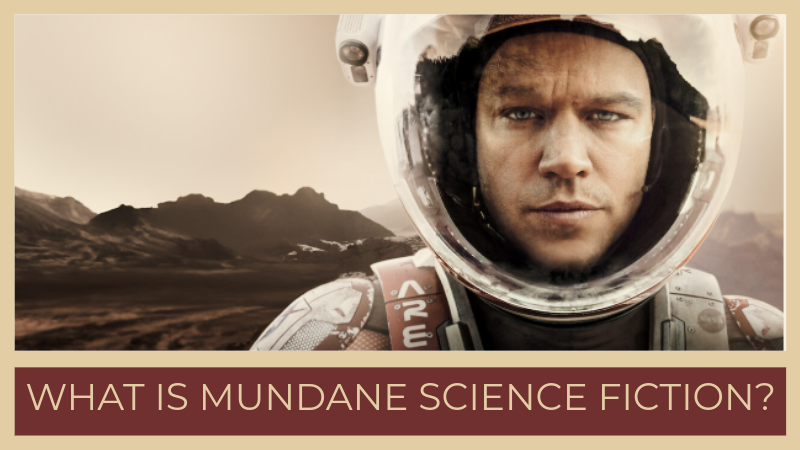
Discover what defines the mundane science fiction genre, its core characteristics, and standout story examples.
What Is Mundane Science Fiction?
Mundane. Dreadful name, isn’t it? I mean, who wants to write mundane anything, let alone science fiction? It sounds no more thrilling than a shopping list or a set of instructions on ‘how-to-put-a-plug-on-your-bedside-lamp’! Does mundane science fiction have a chance with what could, and has, been described as a genre marketing nightmare?
Different genre descriptions have been suggested. These include near-future science fiction, post-cyberpunk science fiction, satirical futurism, and realistic near-future hard science fiction.
But let’s start with what mundane science fiction isn’t. It is not your usual science fiction Star Trek, Guardians Of The Galaxy, The War of the Worlds, Alien, etc. In fact, not including aliens and intergalactic space travel sums it up in a nutshell.
What Mundane Science Fiction Doesn’t Have
- There are no aliens – or at least there are no non-human characters from other planets.
- There is no interstellar or intergalactic travel.
- There are no distant futures. The future presented in the books is frighteningly real and close.
- There is no time-travel.
- There are no alternate realities or histories.
- There is no ‘faster than light travel’.
- It avoids the clichés of science-fiction soap operas.
- There are no intergalactic empires or wars.
- There are no ‘special gifts’ a.k.a. psionic powers such as paranormal or psychic phenomena like telekinesis, extra-sensory perception, nanobots, immortality, computer consciousness, mind-uploading, and teleportation.
What Mundane Science Fiction Is
It’s actually not mundane at all. It can be extremely exciting if written well. There are some exacting criteria though, and if you want to write in this speculative fiction genre, you will need to stick within this framework. Don’t think of it as restricting your imagination. Rather take it as a challenge to show readers how good a writer you actually are.
It may involve some serious research as well as fairly good understanding about biology, genetics, robotics, AI, science, and scientific prophecies – what scientists predict out near-future could possible be like, and what dangers we are currently throwing ourselves into without serious and due consideration.
Writing Tip: If you do choose to write mundane science fiction – do your research. Find a friendly astrophysicist, biologist, bio-technologist, scientist, tech-scientist, etc., to bounce plot ideas off, and to alpha read your first draft, to make sure you haven’t veered into the fantastical elements of Star Trek territory.
Characteristics: What Mundane Science Fiction Must Have
- It’s set on Earth, or within our Solar System.
- It often examines what the impact of today’s scientific discoveries will have on humans and the future of our society.
- The science is either what already exists or what can feasibly and believably exist in the near future.
- There is near-future realism.
- It often poses ‘what-if’ questions regarding our trashing of the planet, playing God when it comes to genetics, enhanced genomes, quantum mechanics, nanotechnologies, releasing technologies before they have been properly developed and tested, such as AI, virtual reality, and robotics.
- Mundane science-fiction can describe change that is already in motion.
- Depending on the plot it can possibly have ideological significance.
- While there shouldn’t be interstellar travel, interplanetary travel that is theoretically feasible in the near future – like going to Mars is fine.
- Correct or theoretically correct science.
- Characters who know their stuff and can ‘science the shit out of’ any situation in which they find themselves.
- The plot is human-focused.
But, but what about the Force, Klingons on the starboard bow, and pew pews?
Sorry, not in mundane science fiction. How about growing potatoes with your own poop? Which brings us onto the books that have done mundane science fiction brilliantly.
Examples Of Mundane Science Fiction
- The Martian by Andy Weir – Published 2011.
It’s 2035, and Mark Watney, an American astronaut, Astro botanist and mechanical engineer, is stranded alone on Mars. The book explores the human ability to survive under extreme conditions, alone with limited food supplies, extreme weather, and malfunctioning communications with Earth. It’s his resolve to as he says, ‘science the shit our of it’, when he realises survival is entirely up to him. A nice line as human excrement on space missions is saved and not released into space anyway. He uses the saved poop to grow potatoes. Could anyone write a book like this?
The author: Andy Weir studied orbital mechanics, astronomy, and the history of human spaceflight. His research was based on related material and existing technology.
The book’s success: The book spent 76 weeks on the NYT Bestseller List, 19 of those was at the top. - Jurassic Park
by Michael Crichton – Published 1990.
It explores molecular cloning, and genetic engineering, and human greed within the framework of a fast-paced, suspenseful plot blended with scientific, detailed explanations of biotech and chaos theory.
The author: Michael Crichton M.D. from Harvard Medical School and postgraduate studies at the Salk Institute for Biological Studies, giving him a strong foundational knowledge in molecular biology, genetics, and emerging technologies. He spent 10 years researching PCR (polymerase chain reaction) for DNA amplification, the use of amphibian DNA to fill genetic gaps, and the theoretical application of chaos theory to complex biological systems.
The book’s success: It was an almost instant bestseller, spent three months on the NYT Bestseller List. By 1993 it had sold nine million copies, and so far, has had over one hundred reprints.
But what if you’re not a scientist-type, can you still write mundane Science-fiction?
Yes, you can. P.D. James worked in the UK National Health Service, and the Home Office Police Department and later the Criminal Policy Department before becoming a full-time writer. And like all writers, her experience would have given her ample background on which base her novel, The Children of Men.
- The Children of Men by P. D. James – Published 1992. Set in England in 2021, the book explores what happens when failed science and medicine has doomed mankind to extinction. Mass infertility has resulted in the United Kingdom becoming depopulated. No one has been born in the last 25 years. With politics now being meaningless, the UK is now a dictatorship. However, there is a small resistance group, one of whom falls pregnant. The book was made into a movie which did depart from the source material but was itself a mundane science-fiction story. Most dystopian novels can be considered mundane science-fiction.
The Last Word
Mundane science fiction reminds us that the most compelling futures aren’t always the most fantastical. They’re the ones that feel within reach. By focusing on realism, plausible technology, and human-scale stories, this genre offers a fresh lens on where we’re headed. If you’re a writer aiming for authenticity, exploring mundane science fiction might be the genre for you.
Source for image: The Martian, 20th Century Fox

by Elaine Dodge. Author of The Harcourts of Canada series and The Device Hunter, Elaine trained as a graphic designer, then worked in design, advertising, and broadcast television. She now creates content, mostly in written form, including ghost writing business books, for clients across the globe, but would much rather be drafting her books and short stories.
More Posts From Elaine
- A Quick Start Guide To Writing Revenge
- A Quick Start Guide To Writing Emotions
- Why A Good Vocabulary Is Important For Writers
- What Is Cozy Fiction? & How To Write It
- What Is A Cozy Fantasy?
- What is Romantasy & Why Is It So Popular?
- How Much Personal Experience You Need To Write Fiction
- A Quick Start Guide To Writing Crime Fiction
- What Can Jane Austen Teach Writers Today?
Top Tip: Find out more about our workbooks and online courses in our shop.