
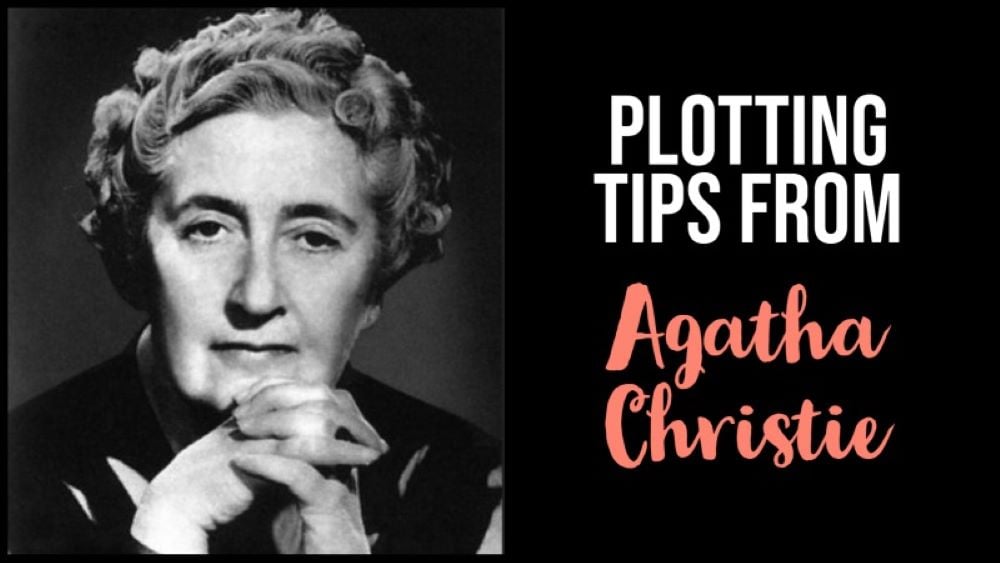
In this post, we share seven plotting secrets from one of the world’s most prolific and successful mystery writers, Agatha Christie.
Whether you’re writing crime fiction or another genre entirely, these timeless techniques will help you craft stronger plots, build suspense, and create unforgettable twists.
Agatha Christie remains one of the world’s bestselling authors. Her iconic detectives, Miss Marple and Hercule Poirot, have stood the test of time, inspiring generations of fictional sleuths and mystery writers. She is credited with creating the cozy mystery fiction genre.
If you want to improve your plotting, Christie is an author worth studying.
Who Was Agatha Christie?
Dame Agatha Christie was born on 15 September 1890 and died on 12 January 1976. She was an English novelist, playwright, and short-story writer best known for her detective fiction.
She wrote 66 detective novels and 14 short-story collections. Her books have sold more than two billion copies worldwide, making her one of the bestselling authors of all time. If you’re new to Christie, And Then There Were None
Here are seven plotting lessons every writer can learn from one of the greatest mystery novelists ever published.
7 Plotting Secrets Every Writer Can Learn From Agatha Christie
1. Start Plotting
‘There is always, of course, that terrible three weeks, or a month which you have to get through when you are trying to get started on a book. There is no agony like it.’ – Agatha Christie: An Autobiography
Beginning a story is often the hardest part of writing. The difference between writers who finish books and those who only dream about writing is simple: they begin. Don’t wait for the perfect idea. Start plotting. Once you have a roadmap, your story becomes much easier to write.
2. Let Your Plot Develop
‘Walking or just washing up, a tedious process. […] Years ago I got my plots in the tub, the old-fashioned, rim kind – just sitting there, thinking, undisturbed, and lining the rim with apple cores.’-Agatha Christie, The New York Times, 27 October 1966
Every writer has a different way of finding ideas. For Agatha Christie, the best plots often emerged while she was doing everyday tasks. Many writers discover that stepping away from the desk allows ideas to connect naturally.
If you’ve found the seed of a good story, give it time to grow. Think about it while walking, gardening, cooking, or doing the dishes. Keep a notebook nearby and write down new ideas as they appear. You can’t force creativity, but you can give your ideas room to grow.
3. Use Your Interests To Enrich Your Plot
‘Plots come to me at such odd moments: when I am walking along a street, or examining a hat-shop with particular interest, suddenly a splendid idea comes into my head…’ – Agatha Christie: An Autobiography
Christie drew on her many interests, including archaeology, travel, and contract bridge, to add detail and authenticity to her stories. Christie, for example, made contract bridge central to Cards On The Table.
Writers can do the same. Pay attention to the things that interest you.
4. Build Your Plot Around Character Flaws
‘My name is Hercule Poirot and I am probably the greatest detective in the world.’ — Hercule Poirot, The Mystery of the Blue Train
Memorable characters aren’t perfect. They’re flawed, contradictory, and deeply human. Hercule Poirot is a good example. He is brilliant, but he is also vain, fussy, proud, and obsessed with order. These traits make him more than a clever detective. They give him personality and create opportunities for conflict and humour.
When creating your characters, look beyond appearance and biography. Give them weaknesses, fears, blind spots, and personal histories. Use these flaws to drive your plot. A character’s pride might lead them to make a bad decision. Their fear might stop them from telling the truth. Their jealousy might create conflict.
5. Explore Your Characters’ Potential
‘Everyone is a potential murderer. In everyone there arises from time to time the wish to kill, though not the will to kill.’ – Agatha Christie, Curtain
Every memorable plot is driven by what characters are capable of doing under pressure. Christie understood that ordinary people can be pushed to extraordinary actions. She explored the darker side of human nature and the difficult choices people make when fear, jealousy, greed, or desperation take over.
When you’re plotting your story, ask yourself what each character is truly capable of. What secret are they hiding? What line would they never cross? What circumstances would force them to cross it? The answers to these questions create conflict, deepen motivation, and open the door to surprising twists. The more believable your characters’ choices are, the more compelling your plot will become.
6. Let Cause And Effect Shape Your Plot
‘To get at the cause for a thing, we must study the effect.’ – The Mysterious Mr Quin
Every event in your story should lead naturally to the next. Ask two simple questions as you plot:
- What if?
- What happens next?
The first generates possibilities. The second creates momentum.
Strong plots are built on cause and effect. Every decision has consequences, and every consequence creates a new problem for your characters. This is why outlines can be especially useful for mystery or horror writers. They help ensure every clue, revelation, and twist fits logically into the chain of events.
7. Don’t Overcomplicate Your Plot
‘It’s never difficult to think of things. The trouble is that you think of too many, and then it all becomes too complicated, so you have to relinquish some of them and that is rather agony.’ – Agatha Christie: An Autobiography
Having too many ideas can be just as difficult as having none. Agatha Christie often had several possible plots competing for her attention. She kept notebooks filled with ideas, characters, clues, and possible storylines. Some became novels, while others were abandoned or changed along the way.
When you’re plotting, don’t try to use every good idea you have. Too many twists, characters, subplots, and complications can make a story difficult to follow. Choose the ideas that best serve your main plot. Then remove anything that distracts from the story you want to tell.
A simpler plot can often make a stronger story.
The Last Word
Great plots don’t happen by accident. Agatha Christie shows us that they come from careful planning, believable characters, and an understanding of human nature. Whether you’re writing a mystery, a thriller, or any other genre, these seven lessons will help you build suspense, strengthen your plot, and keep readers turning the pages.
By Alex J. Coyne. Alex is a writer, proofreader, and regular card player. His features about cards, bridge, and card playing have appeared in Great Bridge Links, Gifts for Card Players, Bridge Canada Magazine, and Caribbean Compass.
If you enjoyed this, you will love:
- 7 Bits Of Poetry Advice From Mary Oliver
- 6 Bits Of Writing Advice From Jorge Luis Borges
- Curtis Sittenfeld’s 5 Steps For Writing A Short Story
- Alice Adams’s Pattern For Writing A Short Story
- 6 Bits Of Writing Advice From Charles Bukowski
- 7 Bits Of Writing Advice From Cormac McCarthy
- Lisa Jewell’s 12 Writing Tips
- 5 Bits Of Writing Advice From Iris Murdoch
- 6 Writing Lessons From Bill Watterson
- Writing Advice From The World’s Most Famous Authors
Top Tip: Sign up for our free daily writing links.