

Learn how to control pacing in your writing with these four essential questions. Discover the structural techniques writers use to shape the rhythm and flow of a story.
All About Pacing: 4 Key Questions Every Writer Should Ask
1. What is pacing?
Pacing is the art of manipulating time in a story—controlling its speed, rhythm, and flow.
“Pacing is part structural choices and part word choices, and uses a variety of devices to control how fast the story unfolds.” ~Jessica Page Morrell, Crafting Novels & Short Stories
Pacing is made up of a range of structural devices that writers use to control the speed and flow of a story.
These include:
- Scene
- Sequel
- Dialogue
- Reflection
- Word choice
- Sentence structure
- Suspense
- Cliff-hangers
- Scene lengths
- Chapter lengths
Most beginners overwrite and this influences pacing. We all end up padding our first stories with too much description. We tend to summarise long parts of the story and repeat sections. This is mainly because we do not have a good enough plot.
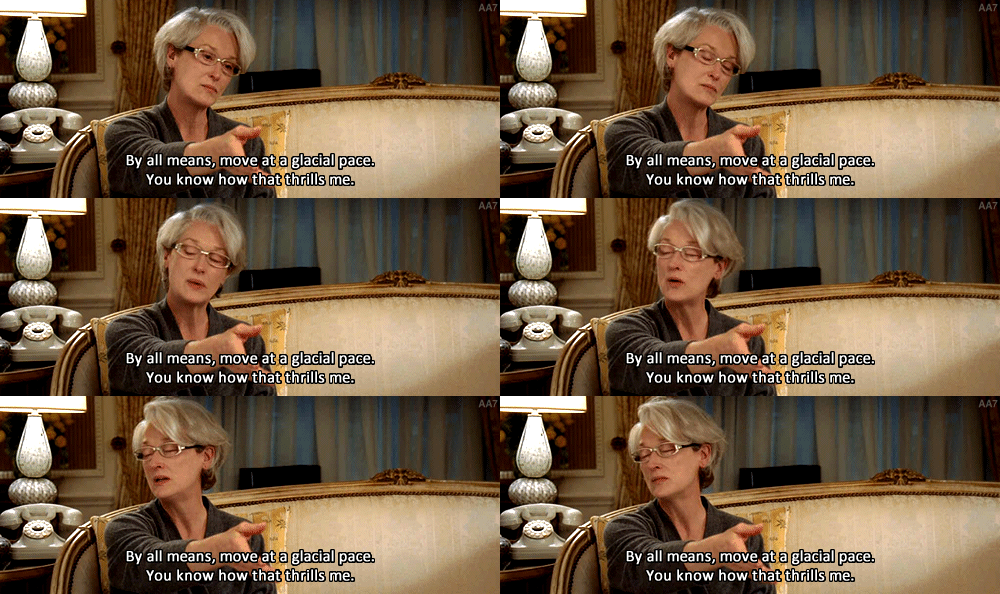
2. How do I know if pacing is a problem?
Mechanically, this exercise is an excellent way to check on overall pacing problems.
- Read your work out loud – and that means every single word. If your voice trips over a word or phrase –delete it or revise it.
- Circle every ‘is’, ‘was’, ‘are’, and ‘were’. Unless you are using the verb ‘to be’ replace them with strong verbs.
- Delete unnecessary adverbs.
- Delete unnecessary adjectives.
- Ensure that more than 50% of your book consists of dialogue.
If you do not have many words left after you have done this, you need to work on your plot. You need to plan 60 relevant scenes that will get your book from the beginning through the middle to the end. If you still cannot do this, you may not have a novel. You may have a short story or a personal essay.
3. How do I change pace?
Pacing differs with the needs of a story. For example:
- A fantasy epic can be written at a leisurely pace, with action scenes and important events highlighting and speeding up the story.
- A short story is usually three scenes, two of those are action, and one is reflection.
- A crime novel is written at a fast, action-packed pace, with shorter scenes that deliver moments of reflection and respite.
You need to increase pace in action scenes and slow down your pace in reflective scenes (sequels). Understanding scene and sequel and their structure is crucial to perfecting pacing. We refer to scenes as action mode and sequels as summary mode.
You need to ‘show’ most of the time when you write, but you need to highlight ‘showing’ in scenes. Sequels are the time for ‘telling’.
Tip: You should work towards having 75% of your novel in action scenes and 25% in reflective scenes.
4. What are the mechanics of pacing?
Seven ways to increase pace:
- Keep most of your sentences short.
- Stay in the active voice.
- Use fragments.
- Take out unnecessary adverbs.
- Do not use unnecessary adjectives.
- Try to use the best nouns and the strongest verbs.
- Use lots of relevant dialogue.
Six ways to slow down:
- Offer more setting details, but do not induce a coma with this.
- Make your sentences longer.
- Use the passive voice.
- Use some adjectives.
- Always remember that a tiny pinch of adverb goes a very long way.
- Include more internal reflection by the viewpoint character, along with the dialogue.
The Last Word
Pacing is one of the most powerful tools you have as a writer. It shapes how readers experience your story from beginning to end. To perfect your pacing, you will have to work on all 10 of the structural devices I mentioned at the beginning of the post. Each one plays a role in creating rhythm, tension, and momentum on the page. I hope that these tips help you fix your pacing problems, so you can craft stories that keep readers turning the pages.
You can also read: How To Pace A Romance Novel

by Amanda Patterson
© Amanda Patterson
If you enjoyed this blogger’s writing, read:
- Past Tense Or Present Tense: Which Works Best For Your Story?
- A Guide To The 17 Most Popular Fiction Genres
- How To Write A Spy Novel
- How To Outline A Short Story – For Beginners
- 6 Sub-Plots Every Writer Should Know
- How To Write Great Dialogue In Fiction
- What Is An Unreliable Narrator? 9 Types Every Writer Should Know
- How Writers Use The 4 Main Characters As Literary Devices
- Mastering Point Of View In Writing
- 7 Essential Elements Every Writer Must Master
Top Tip: Sign up for our free daily writing links.