
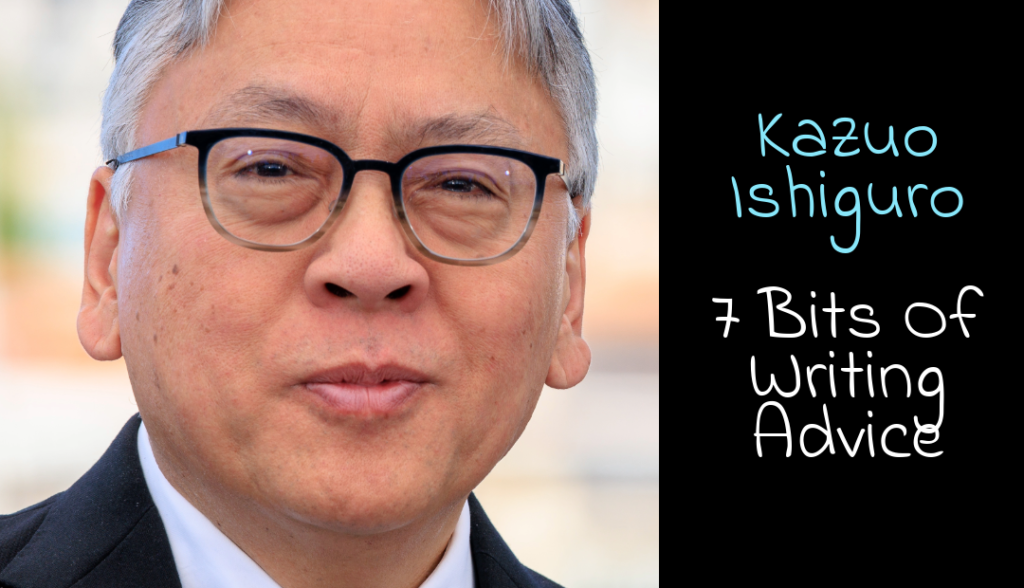
7 Bits Of Writing Advice From Kazuo Ishiguro
Discover seven bits of writing advice from Nobel Prize-winning author Kazuo Ishiguro, from choosing a viewpoint to exploring new ideas.
Kazuo Ishiguro was born on 8 November 1954 in Nagasaki, Japan. He moved to England with his family when he was five.
He is a British novelist, screenwriter, and lyricist. In 2017, he was awarded the Nobel Prize in Literature. He received an OBE in 1995 and was knighted in 2018 for services to literature.
Ishiguro is known for writing across genres, including literary fiction, historical fiction, and science fiction. His novels explore themes like memory, identity, love, loss, and self-deception. Some of his later work also explores artificial intelligence and dystopian societies.
He published his first novel, A Pale View Of The Hills, in 1982. Other novels include An Artist Of The Floating World, The Remains Of The Day, Never Let Me Go, and Klara and the Sun. Ishiguro won the Booker Prize in 1989 for The Remains of the Day.
He also writes song lyrics and has collaborated with jazz singer Stacey Kent. His daughter, Naomi Ishiguro, is also a writer.
7 Bits Of Writing Advice From Kazuo Ishiguro
1. Take Breaks, You Need Them
‘When it comes to the writing of novels, however, the consensus seems to be that after four hours or so of continuous writing, diminishing returns set in.’– The Guardian
Writing for long periods of time becomes less productive as your concentration fades. You don’t have to spend every available hour writing. Take a walk or have some coffee. A short break lets you to you go back to your story with fresh eyes.
2. Viewpoint Choice Is Power
‘I am not really that interested in what happened. I’m much more interested in what the narrator thinks happened. That battle people have with themselves about what they think they did or who they think they are.’ – The Irish Times
The difference between what happened and what a character believes happened creates fascinating stories. Your characters may not remember events correctly, misunderstand someone’s intentions, or hide the truth from themselves. Ask yourself: What does your character know, believe, and refuse to see? This provides some of your most interesting material.
3. Stories Are Important
‘When we create stories for movies or just stories that we tell each other when we meet, this is something very, very fundamental.’ – The Washington Post
Storytelling helps us make sense of our experiences and connect with others. As a writer, pay attention to the stories people tell in everyday life. Notice what they leave out, what they emphasise, and how they describe events. These observations can help you write interesting characters and dialogue.
4. Writing Needs Planning (& Not)
‘Most writers have certain things that they decide quite consciously, and other things they decide less consciously.’ – The Paris Review (No. 196)
Writing involves deliberate decisions and discoveries you make along the way. You need to plot and develop your characters. But leave room for unexpected dialogue, new ideas, and scenes that take you in a different direction. This may take your story somewhere better than you planned.
5. Writing Is (A Lot Of) Work
‘Don’t take on a creative project lightly.’ – An Interview With Richard Beard
Starting a novel is easy, but finishing it takes commitment. You need to keep going when the going gets tough, your confidence fades, and the first draft needs revising. Before you begin, ask yourself whether you have the time and energy to see the project through. Writing a book is a long-term commitment.
6. Explore New Topics
‘Write what you know is the most stupid thing I’ve heard. It encourages people to write a dull autobiography. It’s the reverse of firing the imagination and potential of writers.’ – Shortlist
Writing from experience can be useful, but it shouldn’t limit your imagination. Research allows you to explore unfamiliar places, professions, historical periods, and ideas. Use what you learn to create characters, settings, and plot twists. Don’t let ‘write what you know‘ stop you from discovering something new.
7. Allusions Can Ruin The Message
‘I don’t like to work with literary allusions all that much.’ – Guernica Mag, Mythic Retreat Interview
Literary allusions add meaning to a story, but they shouldn’t exclude readers. Not everyone recognises the same books, poems, or historical references. Make sure your writing communicates without relying on readers to understand something. Use references when they enrich your story, not when they are difficult to understand.
The Last Word
Kazuo Ishiguro reminds us that good writing takes patience, curiosity, and hard work. These seven bits of advice encourage us to think about viewpoint, make room for imagination, and keep learning. Most importantly, they remind us that there is always more to discover when we write.
Source for photograph: Martin Kraft, CC BY-SA 4.0, via Wikimedia Commons
If you enjoyed this, you will love:
- 10 Bits Of Writing Advice From Colson Whitehead
- 9 Bits Of Writing Advice From Naomi Alderman
- 9 Bits Of Writing Advice From Guillermo del Toro
- Trudi Canavan’s 3 Tips To Improve Your Writing
- Nora Roberts On How She Writes
- 7 Bits Of Writing Advice From H. G. Wells
- Gail Carson Levine’s 7 Rules For Writing
- 7 Excellent Plotting Tips From Agatha Christie
- 6 Bits Of Writing Advice From Jorge Luis Borges
- Writing Advice From The World’s Most Famous Authors
Top Tip: Sign up for our free daily writing links.
Posted on: 8th November 2021
(19,076 views)