
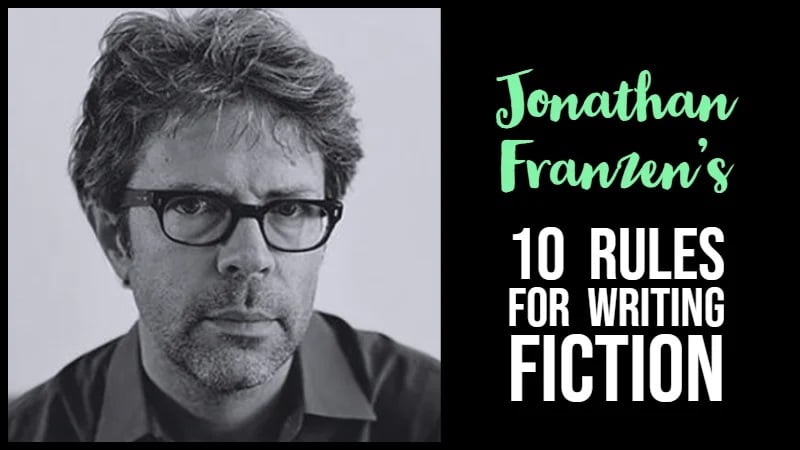
Discover Jonathan Franzen’s 10 rules for writing fiction, from trusting the reader and taking creative risks to choosing viewpoint, using research, and writing with purpose.
Jonathan Franzen (born on 17 August 1959) is an American novelist and essayist. His fiction is known for its detailed and layered portraits of contemporary American life.
Franzen gained widespread critical acclaim with his 2001 novel The Corrections. The book won the National Book Award and was a finalist for the Pulitzer Prize for Fiction. It also won the James Tait Black Memorial Prize and was shortlisted for the International Dublin Literary Award.
His later novel Freedom, published in 2010, was another major success. It led to Franzen appearing on the cover of Time magazine with the headline ‘Great American Novelist’. His other novels include The Twenty-Seventh City, Strong Motion, Purity, and Crossroads.
Franzen has also written several works of non-fiction and translation, including Farther Away and The Kraus Project. He is a member of the American Academy of Arts and Letters and the German Akademie der Künste, and he has been awarded France’s Ordre des Arts et des Lettres.
Jonathan Franzen’s 10 Rules For Writing Fiction
- The reader is a friend, not an adversary, not a spectator.
- Fiction that isn’t an author’s personal adventure into the frightening or the unknown isn’t worth writing for anything but money.
- Never use the word ‘then’ as a conjunction – we have ‘and’ for this purpose. Substituting ‘then’ is the lazy or tone-deaf writer’s non-solution to the problem of too many ‘ands’ on the page.
- Write in the third person unless a really distinctive first-person voice offers itself irresistibly.
- When information becomes free and universally accessible, voluminous research for a novel is devalued along with it.
- The most purely autobiographical fiction requires pure invention. Nobody ever wrote a more autobiographical story than The Metamorphosis.
- You see more sitting still than chasing after.
- It’s doubtful that anyone with an internet connection at his workplace is writing good fiction.
- Interesting verbs are seldom very interesting.
- You have to love before you can be relentless.
Source for 10 Rules
Source for screenshot

If you enjoyed this, you will love:
- Sue Monk Kidd’s 10 Most Helpful Writing Tips
- Rose Tremain’s 10 Rules For Writers
- 27 Gems On Writing From Ernest Hemingway
- Billy Wilder’s 10 Tips For Writing Screenplays
- Colm Tóibín’s 10 Rules for Writing Fiction
- Roddy Doyle’s 10 Rules For Writing
- Writing Advice From The World’s Most Famous Authors
Top Tip: Sign up for our free daily writing links.