
Blackout poetry is an exciting modern poetry genre. This post explains what this genre is about and how to write blackout poetry.
Blackout poetry – the name alone is very suggestive. But you don’t need to lose consciousness, it’s not about imposing a gag order, and the absence of electric power has nothing to do with it.
To engage in this form of poetry, the writer takes a marker and hunts down suggestive words in someone else’s texts. The other words, the ones that are discarded, are blacked out. That, in a nutshell, is blackout poetry. But, of course, there’s more to it than meets the eye.
What Exactly Is Blackout Poetry?
Blackout poetry is a modern form of a palimpsest. A palimpsest is an ancient technique that dates to the time when poetry was written on parchment made of goat or calf skin. This writing material was expensive; it was common practice to reuse parchment. People would scrape off the old text and then write the new words on top. Sometimes, however, the old text was legible through the new one. The reader would often be able to read both!
Blackout poetry, too, uses source texts as its raw material. That’s where it gets interesting. Which source do poets choose? You can easily imagine that it does make quite a difference if you use a page from the Bible or from Lewis Carroll’s Alice in Wonderland
Depending on what poets want to do, they can let the source text shine through or not. If they do choose to show bits and pieces of the source, then this creates a relationship between the source and the new poem. That can add another layer of meaning to the new text.
You can, of course, also black out the original (hence the name). For example, American poet laureate Tracy K. Smith used the Declaration of Independence to create her blackout poem ‘Declaration’. She chose not to show the original. Of course, the source text, in this case, is so well-known that people know it anyway.
But blackout poetry is more than just a palimpsest. Its other root lies in the playfulness of surrealist and dadaist poetry (roughly 1915-25). The surrealists believed that coincidence, luck, and play were fundamental to creation. All poets needed to do was open their minds, and then the poem would reveal itself. They would find it. In this sense, any poem is a found poem.
An important feature of the genre of blackout poetry is that poets may also shape the way the new poem is laid out on the page. The visual appearance provides another layer of meaning. Lisa B. Woods’s art project features a blackout poem by a poet named ‘Maizie,’ created from Bram Stoker’s Dracula
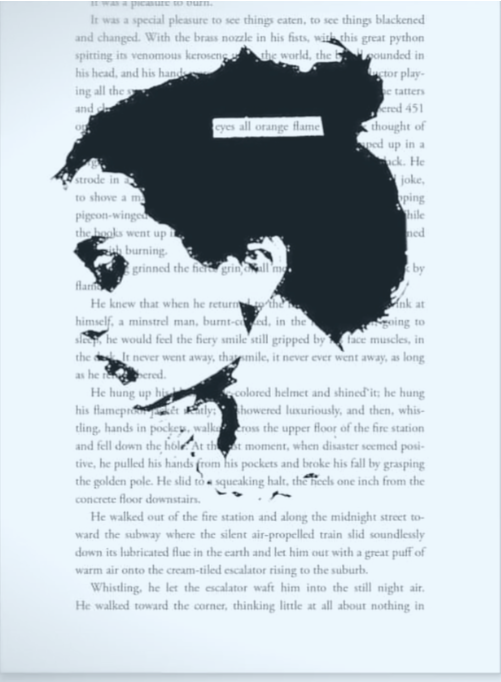
Image source: Lisa B. Woods
The actual poem is just one line, appearing inside a woman’s brain, and shown in the context of the source text. It’s all these things rolled into one poem.
Let’s look at how to produce blackout poems, and then things get much clearer.
How Do I Write A Blackout Poem?
Strictly speaking, you don’t write it at all! It’s more a question of choosing the words. First, you need a few ingredients to make this work. Here’s my recipe, with examples of my own:
1. Choose a page of a text that is meaningful to you. This can be anything. From the instruction manual for your bookshelf, to a cooking recipe, a doctor’s report, or your favourite book. Many poets simply take a page from the newspaper. I have chosen a page from Lewis Carroll’s Alice in Wonderland:
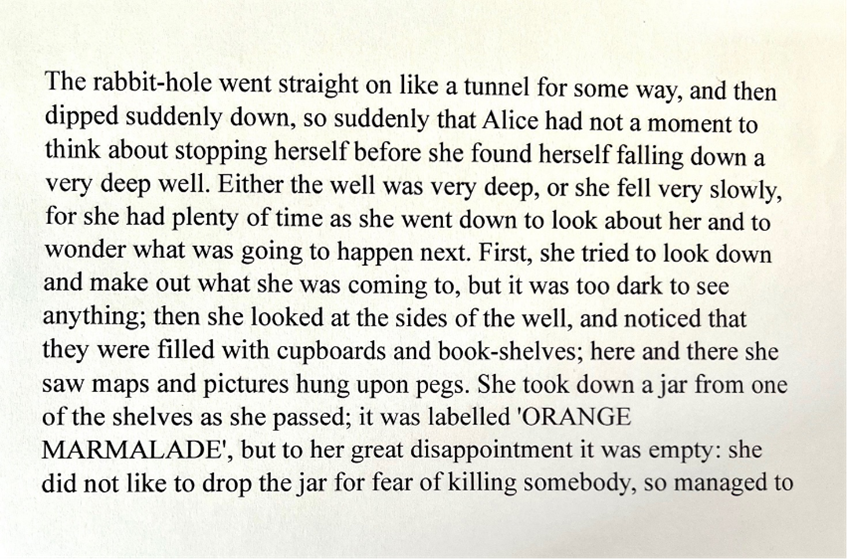
Image source: © Susanne Bennett
2. Scan the entire text. Look for words that stand out in some way, which resonate with you. These words can be charged with meaning; they can be evocative, sensual, or even the complete opposite.
3. Take a pencil and lightly (!) circle these words. Do it carefully as you may end up not using all of them. In my experience, it’s best not to circle more than three words in one line. Otherwise, there’s no limit to how many words you circle.
4. List the circled words on a fresh piece of paper. The words must remain in the exact order as they appear in the text. It will be the way your reader will read them.
5. Make sense of the words on your list. Use the words to create the lines of your own poem. Remember, you don’t have to use all the words on your list, and you will be able to blackout beginnings or endings of words if that enhances your meaning. If you get stuck, go back to the original text. Maybe the word you need is there. Then you may add a new circle. You can also write different versions of your poem on your extra sheet of paper.
6. Circle the chosen words in the source text. Remember to erase the circles of the words you didn’t use. This is what my example looks like:
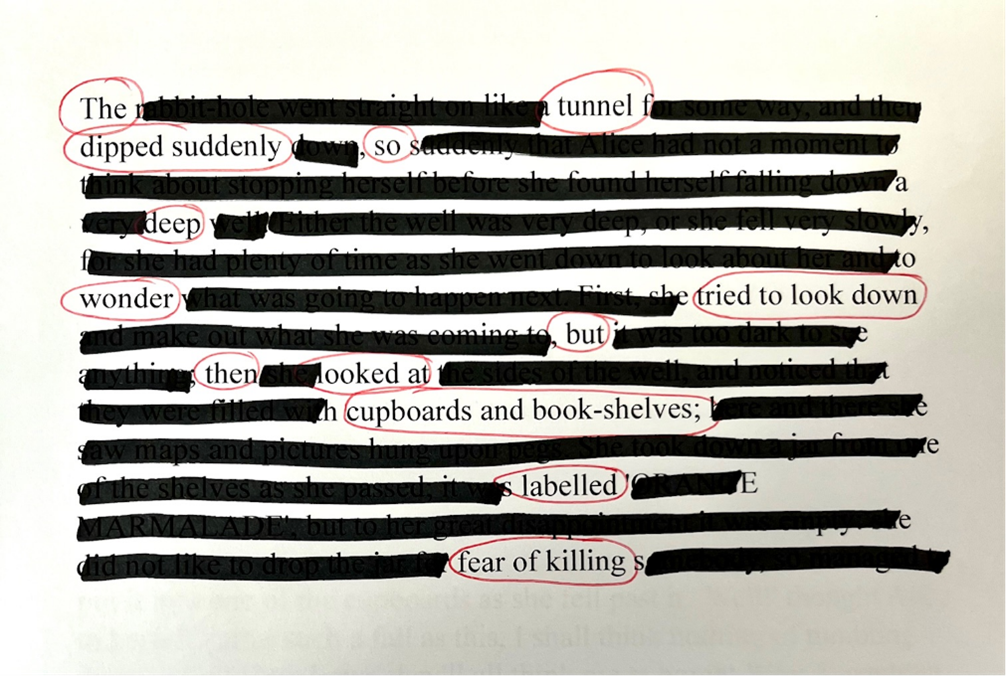
Image source: © Susanne Bennett
7. Think about an image that might enhance your meaning. Sometimes, the way the circled words are spread out on the page already gives you an idea. But if that doesn’t happen, or you feel you just can’t draw, then don’t worry. Images are nice, but optional. Here’s my try – I have no talent at drawing, either.
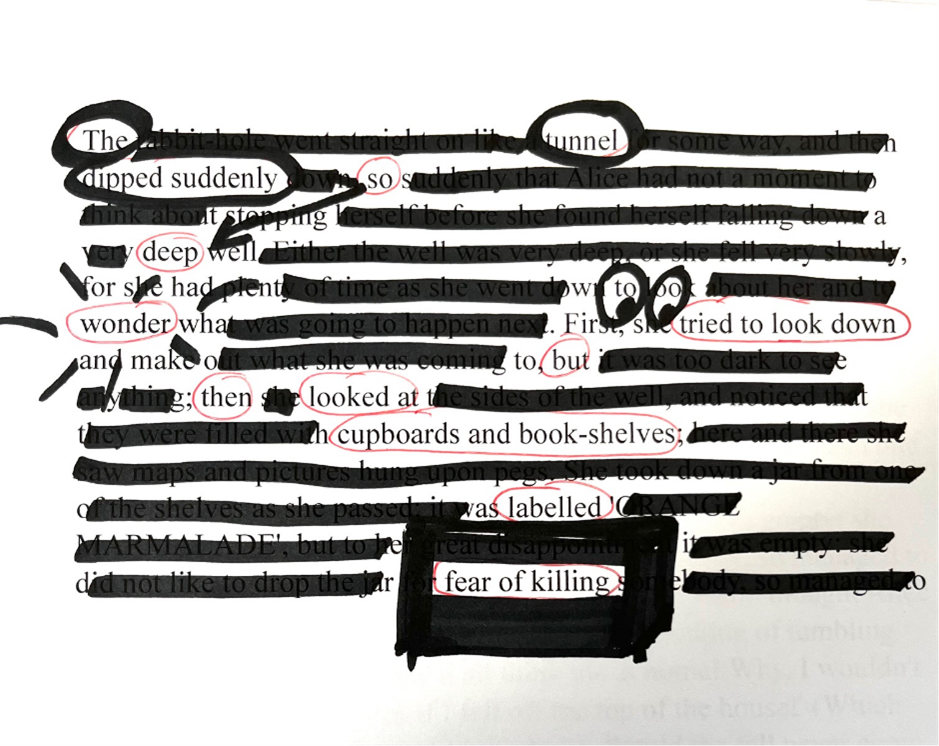
Image source: © Susanne Bennett
8. Blackout all the words your poem doesn’t need. And there you go. Congratulations on your first blackout poem!
5 Reasons To Write Blackout Poetry
- Blackout poems are fun. That’s the whole point. They happen when poets fool around.
- Blackout poems don’t need to be black and white. You can also use bold colours to paint onto the text. Turn your poem into a piece of art!
- Impostor syndrome doesn’t stand a chance. Blackout poems are ‘found’ poems. In this sense, you don’t need to create them; you need to find them. Artist Lisa B. Woods calls this ‘un-writing,’ because someone else wrote the source text. So, don’t worry about whether you’re a true writer or not. Anyone can do a blackout poem. Many teachers use this to teach poetry in school!
- Blackout poems fuse text and image. Everybody can do this. You don’t need to be an accomplished artist. The way your text is laid out on the page is already creating a visual.
- They have more levels of meaning than conventional poems. By linking the source text with your own message and turning this into an image, you already have three levels of meaning. That’s not counting the different meanings each word can have. It doesn’t get any more meaningful than this.
The Last Word
I hope I have convinced you to give blackout poetry a try. If not, then I have one more thing that might just do the trick. Emma Winston created this blackout poetry generator (click the link) that makes blacking out so easy. You can choose between three different source texts: Lewis Carroll’s Alice in Wonderland, Jane Austen’s Pride and Prejudice
Get your markers ready, set go! Happy writing.
Further Reading:
Source for image: Pixabay

By Susanne Bennett. Susanne is a German-American writer who is a journalist by trade and a writer by heart. After years of working at German public radio and an online news portal, she has decided to accept challenges by Deadlines for Writers. Currently she is writing her first novel with them. She is known for overweight purses and carrying a novel everywhere. Follow her on Facebook.
More Posts From Susanne
- 6 Lessons From Lord Byron – How To Make Others Swoon With Words
- How To Write A Cozy Mystery
- The Writers Write Book Reading Challenge – 3
- 20 Weird Things Readers Do
- The 5 Most Common Themes In Literature
- What’s A Golden Shovel Poem? & How Do I Write One?
- How Your Writing Tool Shapes Your Text
- Why Writers Should Write By Hand
- What Is A Parody & How Do I Write One?
- The 7 Pillars Of Historical Fiction
- How To Travel Like A Writer
Top Tip: Find out more about our workbooks and online courses in our shop.
2 thoughts on “What Is Blackout Poetry & How Do I Write It?”
Wow, you’ve really outdone yourself on this one, Susanne. Lots of research, clearly explained and illustrated.
Thank you so much for your kind words! Hope my blog makes you want to try this yourself!
Comments are closed.