
Learn how to write a passive lead character by using conflict, consequences, contrast, and pressure to drive the story.
Are you writing about a character who fails to act? In this post, we discuss the challenge of writing a passive lead character.
As writers, we’re taught that our characters must never be passive. If our character is passive — the classic doormat, or victim — there must be terrible consequences for their inaction.
If nothing happens because your character does nothing, you may struggle to create a story. But if their failure to act creates conflict, changes relationships, and makes their situation worse, that inaction can become an important part of the plot.
The Challenge Of Writing A Passive Lead Character
Here’s a scenario: Sarah, a freelance PR agent, is looking for a flash disk in her husband’s home office. She wants to save a presentation for a new client. On the disk, she finds a spreadsheet of her husband’s expenses. She’s shocked to learn he pays a monthly school fee to a prestigious school in another province. The only problem is the couple have no children.
What does she do? What if she does … nothing? Just closes the drawer and walks out of the room.
What Are The Consequences?
If Sarah doesn’t confront her husband or investigate the payments on her own, she’s going to be tortured by this secret — by mistrust, doubt, and fear. It will affect her marriage. She will be suspicious of every business trip, late night at the office, telephone call, even the way he looks at her. Her inner conflict is going to grow in silence. She has chosen not to ask questions, but that choice does not make the problem disappear. Instead, the secret follows her into every part of her life.
Force Her Hand
As you can see, getting a plot from the above is going to be difficult if Sarah simply continues to do nothing. That’s why, in most stories, something will have to happen to force the character to act, even if it’s in an irrational way.
-
Her friend might spot a picture on Facebook of her husband and a young child at a school event and tell her about it. Now the shell around the secret is starting to crack.
-
Maybe her husband is hurt or killed in a car accident, and the school will call to find out who will continue the payments. She’ll be forced to make a decision.
The pressure on Sarah increases because the secret can no longer be ignored.
Change And Contrast
The reason we put conflict in a story is to force a change in the character through inner conflict. If your character is incapable of change, and that’s the point of the story, you have to build the story around that.
-
Perhaps Sarah’s inability to face her husband’s secret causes her to start drinking, or lose a major PR client, or fall into an aimless affair with another man. Her husband leaves her.
-
Maybe when he finally comes clean and admits the child he supports is not his biological child, but the child of an ex-girlfriend who died, Sarah can’t accept that he didn’t tell her and the marriage breaks up.
Her inaction has consequences. It affects her work, her relationships, and ultimately her marriage.
If you’re going to write a passive character, one way to balance them out is to show some sort of contrast. While Sarah can’t confront the secret in her marriage, she is successful in her PR career and she works obsessively to avoid her personal problems.
Provoke Them
Another way to put the heat on your passive character is to surround her with characters who try to challenge her dormant state. Maybe Sarah has a friend who is always provoking her, a domineering mother who wants to ‘fix’ her marriage, or a new client who is trying to get her to work for his company.
These characters can challenge the choices she is making — or the choices she refuses to make. They can ask the questions she doesn’t want to answer, push her into situations she would rather avoid, and make it harder for her to remain passive.
A character can fail to act and still drive a story — as long as their inaction creates conflict, pressure, and consequences.
5 Strong Passive Characters In Literature
Passive protagonists are not unusual in literature. Some memorable characters are defined, at least in part, by their reluctance to act, their detachment, or their refusal to confront the circumstances around them.
- Bartleby from Bartleby, the Scrivener by Herman Melville. Bartleby’s passive refusal to do what is expected of him drives the story and creates increasingly serious consequences for those around him.
- Meursault from The Stranger by Albert Camus. Meursault’s emotional detachment and reluctance to act shape his relationships and ultimately have devastating consequences.
- Esther Greenwood from The Bell Jar by Sylvia Plath. Esther becomes increasingly withdrawn and unable to engage with the life expected of her. Her inability to act becomes part of the novel’s central conflict.
- Nick Carraway from The Great Gatsby by F. Scott Fitzgerald. Nick is largely an observer rather than an active participant. He watches the events around Gatsby, Daisy, and Tom unfold, rarely intervening.
- Arthur Dent from The Hitchhiker’s Guide To The Galaxy by Douglas Adams. Arthur spends the story reacting to increasingly absurd events he has little control over. His reluctance and bewilderment become part of the comedy and keep the reader engaged.
Passive protagonists can work across many genres. Literary fiction often explores their inner lives, while mystery, romance, horror, and comedy can use their hesitation, avoidance, or inaction to create conflict, tension, or complications.
The Last Word
Passive characters can be challenging to write, but they can make compelling protagonists. If you choose this route, remember that a character’s failure to act can be just as important as their actions. Your plot may be subtle, but their inaction must have consequences.
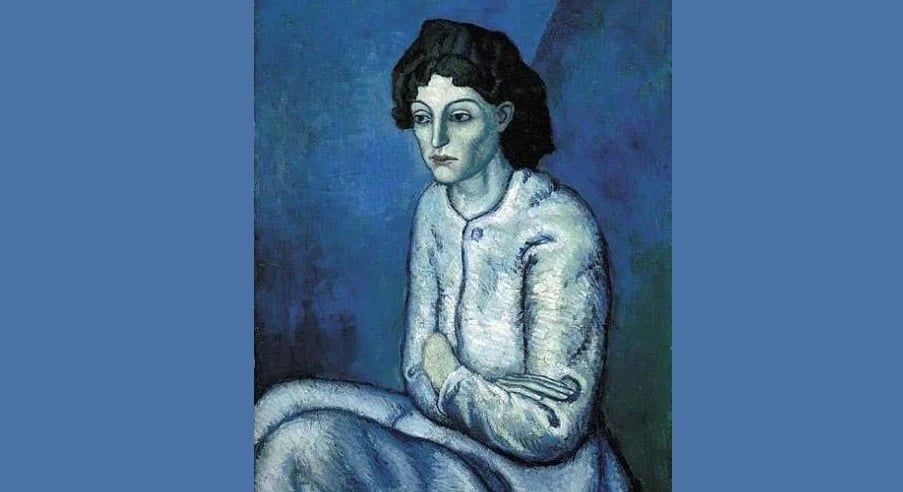
Source for image: Pablo Picasso, 1901-02, Femme aux Bras Croisés, Woman with Folded Arms Reproduction, Public Domain

More Posts From Anthony:
- 7 Types of Narcissists To Use In Your Next Story
- The MacGuffin And Chekhov’s Gun: 2 Literary Devices Writers Should Know
- What Is Visual Storytelling? 10 Essential Techniques Every Writer Should Know
- 7 Ways ‘What If?’ Helps Writers Create Better Stories
- 5 Secret Tricks To Strengthen Your Writing
- 5 Famous Writers On Writing A Villain
- 7 Deadly Rules For Creating A Villain
- How To Write The Tragic Love Story – A 10-Step Formula
- 6 Fascinating Fictional Character Types
- 7 Spine-Chilling Tips For Writing An Unforgettable Horror Story
Top Tip: Sign up for our free daily writing links.