
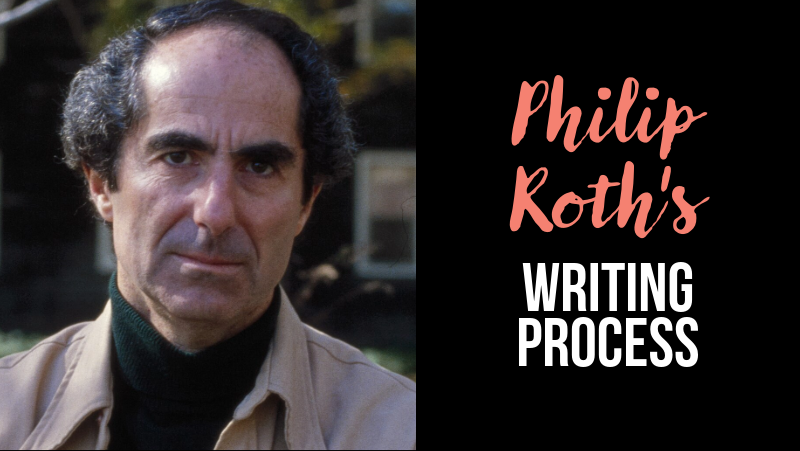
In this post, we explore the award-winning American author, Philip Roth’s writing process.
Philip Roth was born on 19 March 1933 and died on 22 May 2018. He was an acclaimed American novelist and short-story writer known for his dialogue and exploration of Jewish middle-class life. His work dealt with the complexities of love, family, and the challenges of aging.
He was one of the most awarded American writers of his generation. His books twice received the National Book Award, twice the National Book Critics Circle award, and three times the PEN/Faulkner Award. He received the Pulitzer Prize for his 1997 novel, American Pastoral
His other works include Portnoy’s Complaint, The Plot Against America, and The Human Stain. The Zuckerman trilogy follows his writer-protagonist, Nathan Zuckerman’s life. The books are The Ghost Writer, Zuckerman Unbound, and The Anatomy Lesson. Zuckerman is Roth’s alter ego.
President Barack Obama awarded Roth the 2010 National Humanities Medal. He received the Man Booker International Prize in 2011 and retired from writing in 2012.
In this post, we’re sharing quotes from the author about his writing process.
Philip Roth’s Writing Process
- Beginning a book is unpleasant. I’m entirely uncertain about the character and the predicament, and a character in his predicament is what I have to begin with. ~The Paris Review, The Art Of Fiction No. 84
- I work all day, morning and afternoon, just about every day. If I sit there like that for two or three years, at the end I have a book. ~The Paris Review, The Art Of Fiction No. 84
- I often have to write a hundred pages or more before there’s a paragraph that’s alive. Okay, I say to myself, that’s your beginning, start there; that’s the first paragraph of the book. ~The Paris Review, The Art Of Fiction No. 84
- I look for the liveliness to set the tone. After the awful beginning come the months of freewheeling play, and after the play come the crises, turning against your material and hating the book. ~The Paris Review, The Art Of Fiction No. 84
- Writing is frustration – it’s daily frustration, not to mention humiliation. It’s just like baseball: you fail two-thirds of the time. ~The New York Times, 18 Nov. 2012
- I’ll go over the first six months of work and underline in red a paragraph, a sentence, sometimes no more than a phrase, that has some life in it, and then I’ll type all these out on one page. Usually it doesn’t come to more than one page, but if I’m lucky, that’s the start of page one. ~The Paris Review, The Art Of Fiction No. 84
- I turn sentences around. That’s my life. I write a sentence and then I turn it around. Then I look at it and I turn it around again. Then I have lunch. Then I come back in and write another sentence. Then I have tea and turn the new sentence around. Then I read the two sentences over and turn them both around. Then I lie down on my sofa and think. Then I get up and throw them out and start from the beginning. ~The Ghost Writer
- The idea is to perceive your invention as a reality that can be understood as a dream. The idea is to turn flesh and blood into literary characters and literary characters into flesh and blood. ~The Paris Review, The Art Of Fiction No. 84
- If I’m stuck, and I often am stuck, I walk out the door and I’m in the woods. I walk around for 10 minutes, and I come back and try again. ~The Guardian
- I read all the time when I’m working, usually at night. It’s a way of keeping the circuits open. It’s a way of thinking about my line of work while getting a little rest from the work at hand. It helps inasmuch as it fuels the overall obsession. ~The Paris Review, The Art Of Fiction No. 84
- Writing turns you into somebody who’s always wrong. the illusion that you may get it right someday is the perversity that draws you on. What else could? As pathological phenomena go, it doesn’t completely wreck your life. ~ Facebook post by Philip Roth from 6 August 2011
- The road to hell is paved with works-in-progress. ~New York Times Book Review, 15 July 1979
- Nobody sees what I’m doing until I absolutely can’t go any further and might even like to believe that I’m done. ~The Paris Review, The Art Of Fiction No. 84
The Last Word
And after all that work, that torture? Roth says: ‘I believe that we should read only those books that bite and sting us. If a book we’re reading does not rouse us with a blow to the head, then why read it?’ ~The Guardian

If you enjoyed this post, you will love:
- Patricia Hampl On Writing Memoirs
- Bret Easton Ellis’s 2 Bits Of Writing Advice
- Elizabeth George’s Writing Process
- Jules Verne’s Writing Process
- Anton Chekhov’s 6 Rules For Writing Fiction
- Edith Wharton On Writing Fiction
- Elizabeth Strout’s Writing Process
- Harlan Coben On Writing Suspense
- Brandon Sanderson’s 3 Rules For Magic
- 10 Bits Of Writing Advice From Colson Whitehead
- Writing Advice From The World’s Most Famous Authors
Top Tip: Find out more about our workbooks and online courses in our shop.