
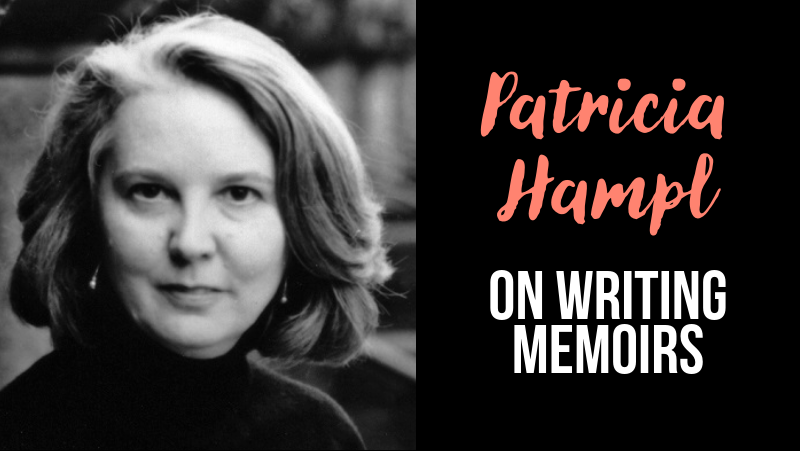
We explore the award-winning memoirist, Patricia Hampl’s thoughts on writing memoirs. We look at the role of memory, the form, the art, and the craft of memoir.
Patricia Hampl was born on 12 March 1946. She is an award-winning American memoirist, writer, poet, and educator. She first won recognition for A Romantic Education, her Cold War memoir about her Czech heritage. She is also the author of the memoirs: Virgin Time: In Search of the Contemplative Life; The Florist’s Daughter; and I Could Tell You Stories: A Sojourn into Memory. She is the editor of, and contributor to, Tell Me True: Memoir, History and Writing a Life.
She was awarded a MacArthur Fellowship in 1990. In addition, she has received fellowships from the Guggenheim Foundation, Bush Foundation, and National Endowment for the Arts (twice, in poetry and prose).
From Hampl’s writing we see that the reason for writing a memoir is about individual perspective, the presentation of the story, and the role of memory. She often interrupts her story to discuss the form of memoir itself. She understands that memory becomes unreliable, particularly as we age.
In her essay, ‘Memory and Imagination’, she places “memoir at the intersection of narration and reflection, of storytelling and essay writing. It can present its story and consider the meaning of the story.” The author holds absolute control over the selection of information, the narrative structure, the portrayal of others, and the interpretation of external influences.
She is not a fan of the celebrity-type/how-I-got-to-be-me memoir, and she writes: ‘I was heartened… to see it was possible to ‘write a life’ and yet not be hopelessly self-absorbed. That it was possible to think with emotion and to feel with intelligence. Here was a writer’s attentive curiosity, as engaged as a scientist studying a slide under the microscope, knowing this attention could lead not only inward, but outward.’ (The Paris Review)
In this post, I’ve selected quotes from the author on the art of memoir writing.
Patricia Hampl On Writing Memoirs
The Beginning
- When I was a child, I had a powerful sense that I wanted to commemorate things. I even remember thinking at the time that it was a strange word for a twelve-year old to use. But of course Catholic children grow up with a lot of long words–’transubstantiation,’ ‘martyrdom,’ ‘veneration’–so maybe ‘commemorate’ wasn’t so much of a stretch. But it is the idea that every life is sacred and that life is composed of details, of lost moments, of things that nobody cares about, including the people who are wounded or overjoyed by those moments. I don’t think people allow themselves to value their lives enough. They ignore and discard these fragments. I would like my writing to be precise enough, detailed enough so that the attention I bring to bear on something unlocks a door to the reader’s life. In that way, by honoring one’s own life, it’s possible to extend empathy and compassion to others. (Alaska Quarterly Review, Fall and Winter 1995)
- I think my fundamental instinct, the thing that brought me to writing as a child and beyond, was and remains a sense of wonder, a luminous amazement at existence. (Creative Nonfiction)
- I was one of those kids who sat at the kitchen table writing stories before I really commanded a pencil. I had to ask my mother how to spell most of the words. So writing was always there, I’m not sure where it came from. Maybe from reading—or being read to. How I loved those sentences coming in a steady pattern as my mother read me Charlotte’s Web. I wanted to do that. I would say the thing that has surprised me—and continues to surprise me—is that I keep writing from the first person voice, from my life, if not about my life all the time. (BookBrowse)
The Routine
- I need solitude for my writing; not like a hermit—that wouldn’t be enough—but like a dead man. (The Art of the Wasted Day)
- Solitude provides the illusion—or is it the reality?—of a self. If I’m alone I can think dark thoughts, be real, be phony, try this, try that. Erase, contradict, forge ahead, double back. (The Art of the Wasted Day)
- Different stages of a book (if we’re talking about writing a book, not writing in general) require different moves. Sometimes I’m reading a lot and taking notes. Sometimes, especially when the research part is mostly done (is it ever done?), I’m full speed ahead and live in the book. I know that’s happening when I move my operations from my desk to the dining room table and live there. (Creative Nonfiction)
The Art
- Words are partly thoughts, but mostly they’re music, deep down. Thinking itself is, perhaps, orchestral, the mind conducting the world. Conducting it, constructing it. (The Art of the Wasted Day)
- We trust memory against all evidence: it is selective, subjective, cannily defensive, unreliable as fact. But a single red detail remembered – a hat worn in 1952, the nail polish applied one summer day by an aunt to her toes, separated by balls of cotton, as we watched – has more real blood than the creatures around us on a bus as, for some reason, we think of that day, that hat, those bright feet. That world. This power of memory probably comes from its kinship with the imagination. (Jay Sennett)
- Memoir is the intersection of narration and reflection, of storytelling and essay writing. It can present its story and consider the meaning of the story. The first commandment of fiction—Show, Don’t Tell—is not part of the memoirist’s faith. Memoirists must show and tell. (Advice To Writers)
- We only store in memory images of value. To write about one’s life is to live it twice, and the second time is both spiritual and historical. (A-Z)
- There is something about being in perfect register with the world in all its troubling, beautiful, cruel complexity that writing accomplishes. For a moment. For a sentence, maybe a paragraph. To articulate loss acutely and accurately, for example, is to be filled, not emptied, companioned, not bereft. (BookBrowse)
- To speak, to write, without charm is to make utterances without reference to a reality outside oneself. It is an act devoid of the playfulness of art, without the attractive humility of one who know absolutely that others exist and therefore feels drawn to please them, because to give them an instant of pleasure is to acknowledge their existence. (I Could Tell You Stories: A Sojourn into Memory)
The Craft
- A careful first draft is a failed first draft. (A-Z)
- Memoir can’t rely on plot as a novel does, yet it has to move over some kind of narrative high wire. Our most ancient metaphor is “Life is a journey,” and I think that provides memoir (and other first-person nonfiction) a natural form. So, travel has been—for me and most (not all) of the books I’ve written—the narrative spine. (Creative Nonfiction)
- I don’t write about what I know: I write in order to find out what I know. (A-Z)
- It’s become a central quest literature of our time. This has partly to do with its formal elements, because you can’t create a plot, really, for a memoir, but you have to have some sort of shapeliness and sense of urgency and trajectory. You need to give readers a reason to keep turning the pages. So memoirs often attach themselves to the idea of the quest, the pilgrimage, the trip, the adventure. (Image)
- It’s strange that we still believe in inspiration when, compared to earlier ages, we seem to believe in so little. Inspiration may be the one bit of God we haven’t managed to kill off. (Blue Arabesque: A Search for the Sublime)
- I think memoir is about a desire to understand rather than simply to narrate. In writing programs there’s a commandment that we all have signed up for, with some eagerness: “show, don’t tell.” It comes from fiction writing. Like all good ideas, it can end up being mechanistic. I don’t think memoir has become so popular simply because people are telling “the truth”—the truth can sometimes be told much more fully in fiction. But memoir allows people an almost eighteen-century relationship to narration that the novel had at the beginning. It allows us to stop and yak for a while, to talk, to ponder, to wonder, to reflect. Memoir has got a kind of Tristram Shandy quality. It’s vignette-driven, episodic rather than truly plotted. (Image)
The Form
- Life is not a story, a settled version. It’s an unsorted heap of images we’re going through, the familiar snaps taken up and regarded, then tossed back until, unbidden, they rise again, images that float to the surface of the mind, rise, fall, drift—and return only to drift away again in shadow. They never quite die, and they never achieve form. They are the makings of a life, not of a narrative. Not art, but life trailing its poignant desire for art. Call them vignettes, these things we finger and drop again into their shoeboxes. (The Art of the Wasted Day)
- I suppose I veer toward memoirists who have an essay mind—that is, writers who aren’t just trying to purvey how-I-got-to-be-me. Rather, I’m interested in writers who come out of the first essay tradition—Montaigne, who certainly isn’t interested in peeling the onion of himself. He pursues the mystery of consciousness, of what his mind makes of the world (not of himself). (Creative Nonfiction)
The Truth
- Memoirists, unlike fiction writers, do not really want to ‘tell a story’. They want to tell it all – the all of personal experience, of consciousness itself. That includes a story, but also the whole expanding universe of sensation and thought … Memoirists wish to tell their mind. Not their story. (A-Z)
- You can’t put much on paper before you betray your secret self, try as you will to keep things civil. (I Could Tell You Stories: A Sojourn into Memory)
- We like the personal essay not just because it tells us about a person’s life, but because it allows an individual, the poor, unarmed, unguarded, individual self an opportunity to investigate something much larger. (Touchstone Interview)
The Memory
- Looking repeatedly into the past, you do not necessarily become fascinated with your own life, but rather with the phenomenon of memory. (A-Z)
- Our capacity to move forward as developing beings rests on a healthy relationship with the past. Psychotherapy, that widespread method for promoting mental health, relies heavily on memory and on the ability to retrieve and organize images and events from the personal past. . . . If we learn not only to tell our stories but to listen to what our stories tell us—to write the first draft and then return for the second draft—we are doing the work of memory. (Memory & Imagination)
- What is remembered is what becomes reality. (A-Z)
- We carry our wounds and perhaps even worse, our capacity to wound, forward with us. If we learn not only to tell our stories but to listen to what our stories tell us … we are doing the work of memory. (I Could Tell You Stories: A Sojourn into Memory)
- For the memoirist, more than for the fiction writer, the story seems already there, already accomplished and fully achieved in history (‘in reality,’ as we naively say). For the memoirist, the writing of the story is a matter of transcription. … That, anyway, is the myth. But no memoirist writes for long without experiencing an unsettling disbelief about the reliability of memory, a hunch that memory is not, after all, just memory. (Women’s Memoirs)
- If we think of memory naively, as a simple story, logged like a documentary in the archive of the mind, we miss its beauty but also its function. The beauty of memory rests in its talent for rendering detail, for paying homage to the senses, its capacity to love the particles of life, the richness and idiosyncrasy of our existence. (I Could Tell You Stories: A Sojourn into Memory)
- Refuse to write your life and you have no life. (A-Z)
The Last Word
I hope you have enjoyed Patricia Hampl’s perspective on writing memoirs. I hope they inspire you to write your own memoir.
If you want to read more about writing memoirs, read:
- The 4 Pillars Of A Memoir
- Writing A Memoir? Narrow Your Focus
- The Ultimate Memoirist’s Checklist
- 5 Ways To Write About Real People In Memoirs
- 5 Common Traits Of A Successful Memoir
- 12 Types Of Memoirs – Which One Is Yours?
Top Tip: If you want to learn how to write a memoir, look into our Secrets of a Memoirist course.

If you enjoyed this post, you will love:
- Bret Easton Ellis’s 2 Bits Of Writing Advice
- Elizabeth George’s Writing Process
- Jules Verne’s Writing Process
- Anton Chekhov’s 6 Rules For Writing Fiction
- Edith Wharton On Writing Fiction
- Elizabeth Strout’s Writing Process
- Harlan Coben On Writing Suspense
- Brandon Sanderson’s 3 Rules For Magic
- 10 Bits Of Writing Advice From Colson Whitehead
- Writing Advice From The World’s Most Famous Authors
Top Tip: Find out more about our workbooks and online courses in our shop.