
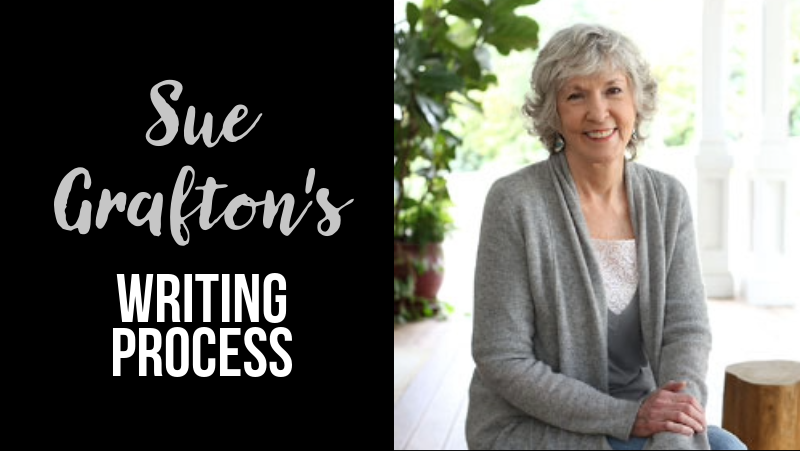
We take a closer look at the writing process of bestselling American crime author Sue Grafton, widely celebrated for her iconic mystery novels.
Sue Grafton was born on 24 April 1940 and died on 28 December 2017. She is best known for her internationally acclaimed ‘Alphabet Series’, which begins with A is for Alibi. The series follows tough, sharp-witted private investigator Kinsey Millhone as she solves crimes in the fictional city of Santa Teresa, California. Grafton continued the hardboiled detective series through Y is for Yesterday, but the final instalment, Z Is for Zero, was never completed before she died.
Throughout her career, Sue Grafton earned numerous prestigious awards and literary honours. She was named a Grand Master by the Mystery Writers of America, and received accolades such as the Lifetime Achievement Award from the Private Eye Writers of America, the Ross Macdonald Literary Award, and the Cartier Diamond Dagger Award from the UK’s Crime Writers’ Association.
In this post, we’re sharing quotes from the author about the writing process that took her from A-Y.
Sue Grafton’s Writing Process: Lessons From A Crime Fiction Master
Make A Time Every Day – And Stick To It
- I’m usually at my desk by 8:30 or 9:00. I like a tidy office because I find messes distracting. Being disorganised wastes time. (Goodreads)
- I think your internal process needs to be geared to the fact that you will show up for work at a certain time every day. From the point of view of your subconscious there is a preparedness. (Psychology Today)
- I try a form of self-hypnosis which I got out of a book from the library. I think it is a way of suggesting to yourself that the job is going to be done, so you suggest to yourself that there will be a period of concentrated and focused work. (Psychology Today)
Journal Your Way Through A Story
- I keep journals for every novel I write, and I start my workday by logging in, talking to myself about where I am in a novel and how I feel. I focus on the scene or story moves coming up. I revise. I worry about pacing and suspense. (Goodreads)
- I write letters to my right brain all the time. They’re just little notes. And right brain, who likes to get little notes from me, will often come through within a day or two. (Goodreads)
- I write a journal for each of the novels. I usually keep the journals about 50 pages long, and create as many as I need. (Writer’s Digest)
- I call it [writing the journal] a long, whiney conversation I have with myself about what I’m doing. It’s just self-talk—what have I done, what am I thinking about doing, what do I imagine will work, what can I do, what can I not do—and I just chase myself from page to page, hoping inspiration will strike. It takes forever. I throw away so many ideas, you would not believe it. And they’re never workable. (Writer’s Digest)
- And I just think it’s good for people to know it’s always hard, at least for me, partly because I’ve never figured out how to do it quicker. I’m slow and I’m meticulous, and that’s just my nature. (Writer’s Digest)
Do Your Research
- I stop sometimes and consult my research library, which is packed with books about crime and law enforcement. If I’m stuck, I call on the small army of experts who assist with each book. (Goodreads)
- I’ve taken classes in self-defense, learned to shoot a handgun, I’ve taken classes in law—not that I would ever be a lawyer—but just so I know enough to fake it out here. (Writer’s Digest)
- For one thing, the mystery novel is a very elegant, delicate, highly structured form. You need to know how to plot, how to structure a story, you need to understand how to make a character work. People who start writing and think they can start with the mystery novel are often defeated before they put that first word on the page. So my advice is to learn your craft with mainstream fiction, where you’re not as stringently challenged and then come to the mystery when you’ve acquired some of the proficiencies that you need. (Chatelaine)
Take A Break
- I break for a brief lunch and then work another couple of hours. (Goodreads)
- Most days, I walk three to five miles when I’ve finished writing. I need the stress relief and fresh air. (Goodreads)
Have A Goal
- My goal from day to day is two pages. Over a period of time that’s a book a year, just about. (Psychology Today)
- It seems to take me 10 months no matter when I start. (Psychology Today)
Try Something New
- The first 18 books were all first person. Then I got to a point I felt, I’ve got to break out of this, I need some air and sunshine in here. I started using multiple point of view. It was liberating. The reader knows more than Kinsey does, which I think is fun. (The Big Thrill)
Trust The Process
- I am only privileged to know what she [Kinsey] chooses to share, and she assures me that some things are just not my business, thank you. I don’t tell her. She tells me. I discover things about her in the process of writing. (Writer’s Digest)
- I’m learning the same lesson every single time. I’m learning to trust the process. I’m trying to remember that writing should be a form of play. (Writer’s Digest)
The Last Word
We took a look at bestselling American crime author Sue Grafton’s writing process. We hope it gave you some tips for your own writing.
Let’s give Sue Grafton the final word for beginner writers. She says you need to take your time as a writer: ‘My big gripe about newer writers is they’re not willing to put the time in. Somebody’ll write one book and they’re asking me who my agent and my editor are, and I’m thinking, Don’t you worry, sweetheart, you’re not any good yet. Give yourself time to get better. Writing is really hard to master.’

If you enjoyed this post, you will love:
- Philip Roth’s Writing Process
- Patricia Hampl On Writing Memoirs
- Bret Easton Ellis’s 2 Bits Of Writing Advice
- Elizabeth George’s Writing Process
- Jules Verne’s Writing Process
- Anton Chekhov’s 6 Rules For Writing Fiction
- Edith Wharton On Writing Fiction
- Elizabeth Strout’s Writing Process
- Harlan Coben On Writing Suspense
- Writing Advice From The World’s Most Famous Authors
Top Tip: Sign up for our free daily writing links.