
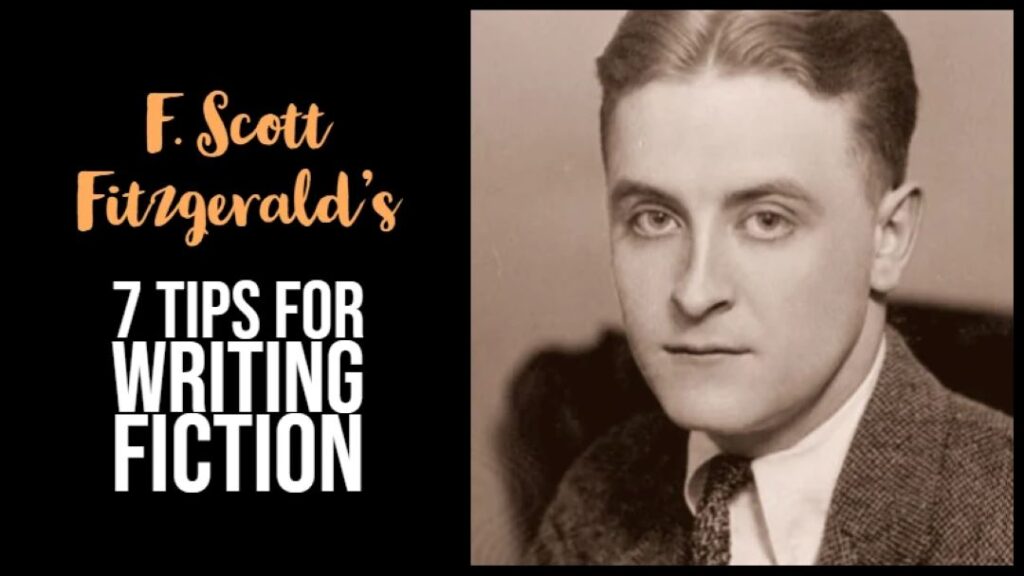
Read F. Scott Fitzgerald’s 7 tips for writing fiction, from taking notes and outlining to creating characters and cutting what doesn’t work.
F. Scott Fitzgerald was born on 24 September 1896 and died on 21 December 1940. He is regarded as one of the greatest American writers of the 20th century and is best known for his novels and short stories about the Jazz Age.
A member of the ‘Lost Generation’ of the 1920s, Fitzgerald completed four novels: This Side of Paradise, The Beautiful and Damned, Tender Is the Night, and his most famous work, The Great Gatsby, which has been adapted for film. His fifth novel, The Last Tycoon, was unfinished when he died and was published posthumously.
Fitzgerald also published four collections of short stories, as well as 164 short stories in magazines during his lifetime. His fiction often explored the failure of the American Dream, along with themes of materialism, class, and romantic idealism.
His private life was almost as well known as his writing. His marriage to Zelda Fitzgerald and his friendship with Ernest Hemingway, particularly during their years in America and France, became part of the mythology surrounding the writer and his work.
F. Scott Fitzgerald’s 7 Tips For Writing Fiction
Open Culture created this list of tips by selecting seven quotations from F. Scott Fitzgerald on Writing, a collection of the author’s remarks on his craft. These have been taken from his works and letters to friends and colleagues
1: Start By Taking Notes
‘You must begin by making notes. You may have to make notes for years…. When you think of something, when you recall something, put it where it belongs. Put it down when you think of it. You may never recapture it quite as vividly the second time.’
Fitzgerald believed writers should write down ideas as soon as they have them. Keep notes about observations, memories, characters, dialogue, images, and anything else that might become useful later. An idea can lose its vividness if you rely on your memory.
2: Make A Detailed Outline Of Your Story
‘Invent a system Zolaesque…but buy a file. On the first page of the file put down an outline of a novel of your times enormous in scale (don’t worry, it will contract by itself) and work on the plan for two months. Take the central point of the file as your big climax and follow your plan backward and forward from that for another three months. Then draw up something as complicated as a continuity from what you have and set yourself a schedule.’
Fitzgerald suggests beginning with a broad plan before you start writing. Identify your central point, work out where the story is going, and then develop the structure around it. A detailed outline and a writing schedule can help you write a long story and keep the plot moving forward.
3: Don’t Describe Your Work-In-Progress To Anyone
‘I think it’s a pretty good rule not to tell what a thing is about until it’s finished. If you do you always seem to lose some of it. It never quite belongs to you so much again.’
Fitzgerald believed writers should keep their stories to themselves until they are finished. Talking about an unfinished idea can change it, and explaining the story to someone else makes it feel less like your own.
4: Create People, Not Types
‘Begin with an individual, and before you know it you find that you have created a type; begin with a type, and you find that you have created–nothing.’
Start with an individual character rather than a character type. Give your characters personalities, desires, contradictions, and experiences. When you create a person, they develop characteristics associated with a particular type.
5: Use Familiar Words
‘You ought never to use an unfamiliar word unless you’ve had to search for it to express a delicate shade–where in effect you have recreated it. This is a damn good prose rule I think…. Exceptions: (a) need to avoid repetition (b) need of rhythm (c) etc.’
Choose words carefully rather than using unfamiliar vocabulary to sound impressive. Use an unusual word if it expresses something specific that a common word can’t. Otherwise, clear, precise language is better.
6: Use Verbs, Not Adjectives, To Keep Your Sentences Moving
‘About adjectives: all fine prose is based on the verbs carrying the sentences. They make sentences move. Probably the finest technical poem in English is Keats’ “Eve of Saint Agnes”. A line like “The hare limped trembling through the frozen grass,” is so alive that you race through it, scarcely noticing it, yet it has coloured the whole poem with its movement–the limping, trembling and freezing is going on before your own eyes.’
Strong verbs give prose energy and movement. Instead of relying on adjectives to tell readers what something is like, choose verbs that show what is happening.
7: Be Ruthless
‘I am alone in the privacy of my faded blue room with my sick cat, the bare February branches waving at the window, an ironic paper weight that says Business is Good, a New England conscience–developed in Minnesota–and my greatest problem: “Shall I run it out? Or shall I turn back?” Shall I say: “I know I had something to prove, and it may develop farther along in the story?” Or: “This is just bullheadedness. Better throw it away and start over.”
The latter is one of the most difficult decisions that an author must make. To make it philosophically, before he has exhausted himself in a hundred-hour effort to resuscitate a corpse or disentangle innumerable wet snarls, is a test of whether or not he is really a professional.
There are often occasions when such a decision is doubly difficult. In the last stages of a novel, for instance, where there is no question of junking the whole, but when an entire favourite character has to be hauled out by the heels, screeching, and dragging half a dozen good scenes with him.’
Writers have to make difficult decisions about their work. There are times when a story, scene, or character is not working. Being willing to cut, change, or even abandon something is just as important as having the determination to keep writing.
The Last Word
F. Scott Fitzgerald’s advice reminds us that good fiction takes more than inspiration. Writers need to observe, plan, create memorable characters, choose their words carefully, and know when to cut what isn’t working. His seven tips offer practical lessons for any writer who wants to make their fiction stronger. (Suggested reading: Between Friends: Writing Advice From Ernest Hemingway To F. Scott Fitzgerald)
Source for image: https://commons.wikimedia.org/wiki/File:F._Scott_Fitzgerald_(1921_portrait_-_crop).jpg

If you enjoyed this, you will love:
- Martin Amis’s 16 Rules For Writers
- Orson Scott Card On Building An Audience
- Jonathan Franzen’s 10 Rules For Writing Fiction
- Sue Monk Kidd’s 10 Most Helpful Writing Tips
- Rose Tremain’s 10 Rules For Writers
- 27 Gems On Writing From Ernest Hemingway
- Anne Lamott On Life And Writing
- Writing Advice From The World’s Most Famous Authors
Top Tip: Sign up for our free daily writing links.