
What is a synopsis? Learn how to write a one-page synopsis for your novel with our easy template, step-by-step guide, and three examples.
If you are looking for a literary agent or a publisher, it’s important to write your story’s synopsis as well as you can. I’ve never met a writer who enjoyed writing a synopsis, so I created this simple formula to help you.
What Is A Synopsis?
A synopsis is an outline of the plot in your play, film, or book. It is a summary of the characters who drive your story, especially the protagonist and the antagonist, and the events that occur in the story. Literary agents ask for a query letter and a synopsis to determine if they want to read your book.
Sometimes, it’s difficult to see your story clearly when you’ve been so involved in the minutiae of your book. Writers often include too much detail in their synopses, or they leave out details that should be there.
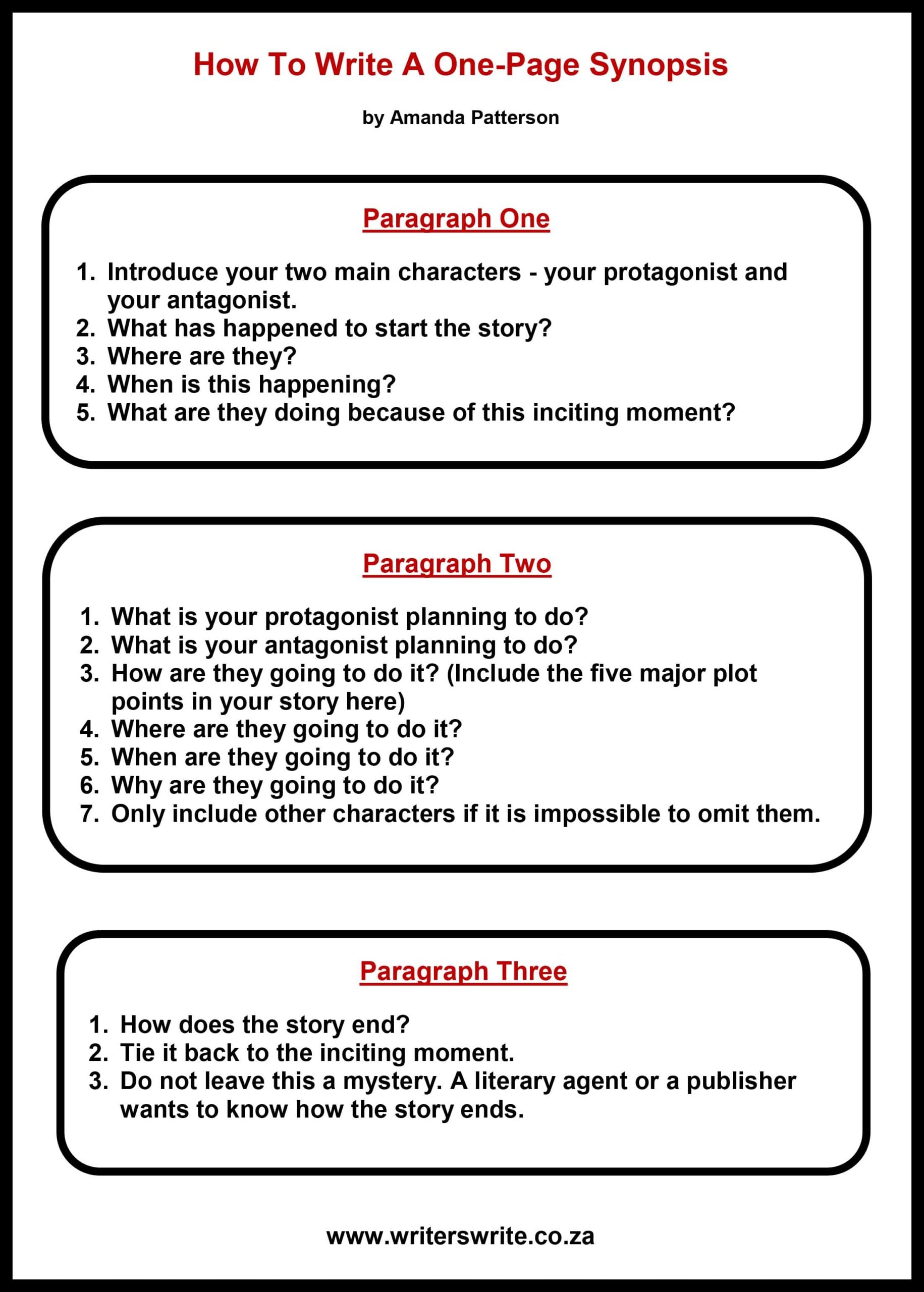
Our formula on this template will help you to write it concisely. I suggest that you answer each question in one sentence. You can also combine some of the answers into one longer sentence. Then combine them to write each paragraph in a clear conversational tone.
[If you need to, please refer to my post on The Five Plotting Moments That Matter mentioned in the template.]
How To Write A One-Page Synopsis – Template
Three Examples Of Synopses Using Our Writers Write Template
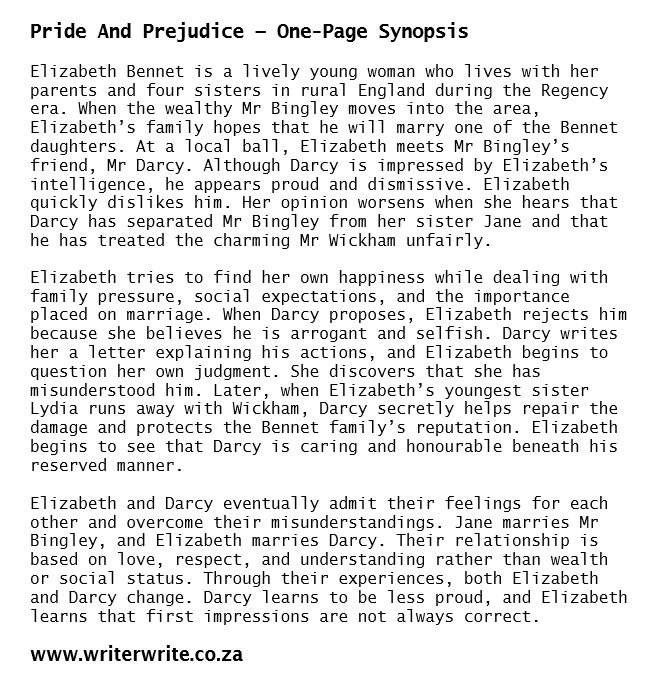
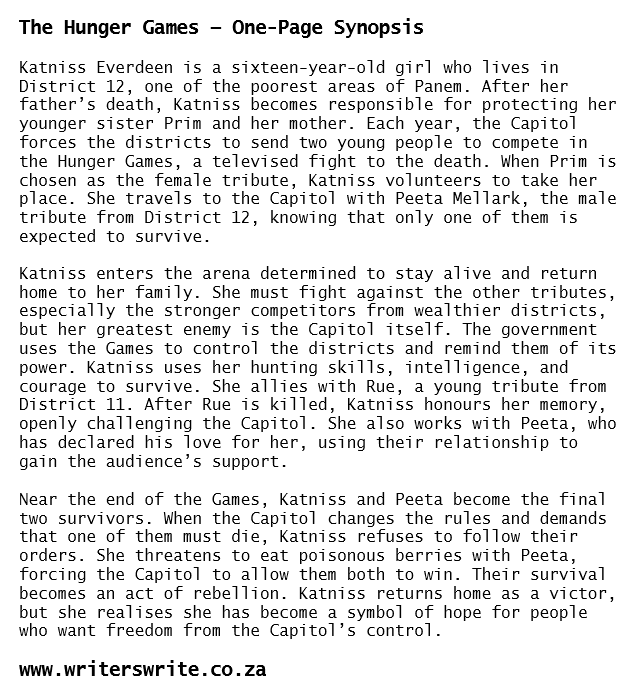
To show you how a one-page synopsis works, we have used three well-known novels as examples: Pride And Prejudice by Jane Austen, The Hunger Games by Suzanne Collins, and Jane Eyre by Charlotte Brontë. Each story uses a different type of conflict and structure, which makes them useful as examples.
In each synopsis, we follow our one-page synopsis template. We introduce the main character, the central conflict, and the events that drive the story forward. We then show how the conflict develops and reveal how the story ends, because a synopsis should explain the complete story arc. It should not tease the reader like a book blurb.
These examples show you how to focus on the most important events, choices, and turning points in a novel while leaving out unnecessary details.
Example 1: Pride And Prejudice
Example 2: The Hunger Games
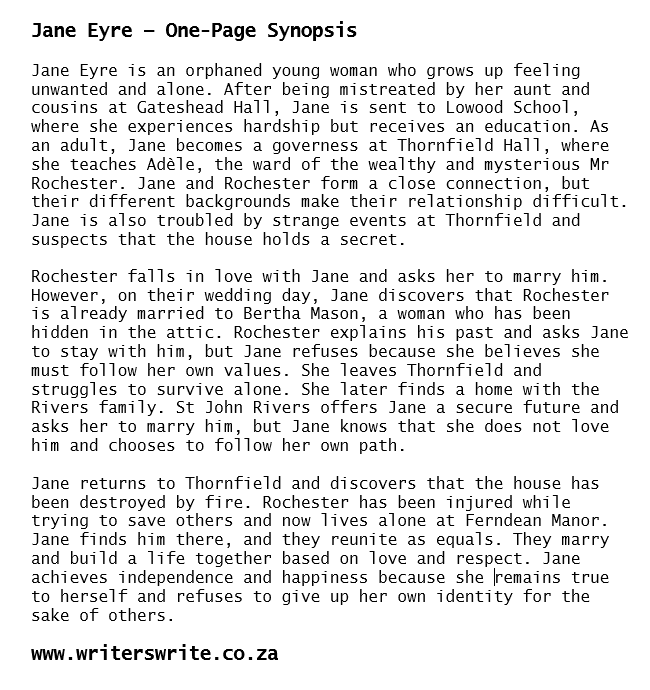
Example 3: Jane Eyre
Three important things to remember about a synopsis:
- A synopsis should be no longer than one page (two if you absolutely have to).
- Use the same 12 point font you have used in your manuscript and query letter. Look for the font you should use on the submission guidelines page.
- Your synopsis should be error-free.
The Last Word
A good synopsis shows that you understand your story, your characters, and the journey you want readers to take. It is not a summary of every detail, but a clear map of the choices, conflicts, and turning points that shape your novel. Use our template, study the examples, and practise writing a synopsis that captures the essence of your story.
When you’re finished the synopsis, you may find our post on How To Write A Query Letter In 12 Easy Steps (With Examples) useful as well.

by Amanda Patterson
© Amanda Patterson
More posts from Amanda:
- 9 Ways To Set Up A Believable Fictional Breakup
- 3 Ways Sidekicks Strengthen Your Novel
- Have You Chosen The Wrong Character As A Protagonist?
- Does Your Character Fight, Freeze, Flee, Or Fawn?
- 30 Character Motivations To Kickstart Your Story
- 5 Instances When You Need To Tell (Not Show) In Your Writing
- What Is A Sequel In Story Structure? A Writer’s Guide
- What Is A Scene In Story Structure? A Writer’s Guide
- How To Write A Gripping Novel: 5 Essential Tips
- How Many Words Should A Novel Be? A Writer’s Guide To Word Counts
Top Tip: Sign up for our free daily writing links.
13 thoughts on “What Is A Synopsis? How To Write A One-Page Synopsis (With Examples)”
Ty so much for this eye opening help-much needed-
Wonderful and concise advice!
thanks for you
very good
http://zaman-jamil.blogspot.com/
Thank you for this post…Wow a real eye opener…
Not only are you gorgeous, you are great…and some other ‘g’ words…
Other ‘g’ words…galuptious, good, grand, gracile, gracious and certainly NOT gallionic…
Thank you for this.
I printed this off for future reference. Synopses have always been a challenge for me. Thanks for the info.
Thank you for the positive feedback. I’m glad it helped.
Thanks
I really like the simplicity of this approach, Amanda. Thank you for posting this!
The length of your paragraphs is also beautifully proportionate to what a reader would like to see in terms of act 1, act2 and act 3.
For a feature film synopsis, I would recommend writing 4 paragraphs, ending the second paragraph on the Mid Point Reversal. This would emphasise the major change that happens halfway.
You’ll also get a great synopsis by covering the main Hero’s Journey stages:
Paragraph 1:
– Ordinary World
– Call to Adventure
Paragraph 2:
– Crossing the Threshold
– (Mid Point Reversal)
Paragraph 3:
– Ordeal/ Reward
– Road Back Home
Paragraph 4:
– Resurrection
For writers of movie screenplays, here is a handy checklist: http://cl.ly/1v2n0K310B2g.
Thank you Amanda for information.
Thank you. I am dumbfounded by the task of writing a synopsis, perhaps because my novel has some structural issues. This simple itemised template not only will help with writing a synopsis, it’s already causing me to think more deeply about the structure I’m trying (and failing to describe). I suspect it will be useful as I restructure my book.
We hope this helps you. It is really difficult to write a synopsis, and this template is a useful tool. Good luck with your book!
Comments are closed.