
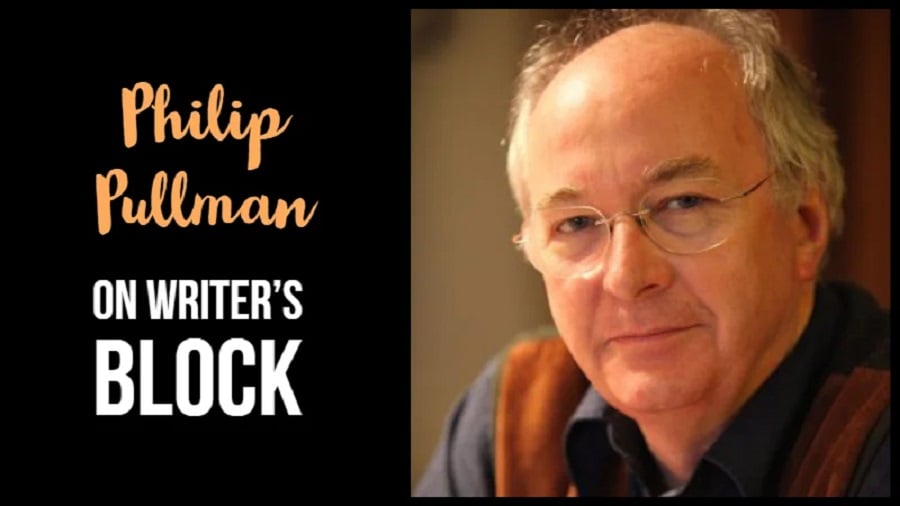
Philip Pullman has a blunt view of writer’s block. Discover why he believes writers should stop waiting for inspiration and get on with the work.
Philip Pullman was born on 19 October 1946. He is an English novelist best known for His Dark Materials, his bestselling fantasy trilogy, and The Good Man Jesus and the Scoundrel Christ, a fictionalised account of the life of Jesus.
Many consider Pullman a worthy successor to J.R.R. Tolkien, author of The Lord of the Rings, and C.S. Lewis, who wrote The Chronicles of Narnia.
In Daemon Voices: Essays on Storytelling, Pullman explores his approach to writing and storytelling. He also has strong views on writer’s block.
Philip Pullman On Writer’s Block
‘Writer’s block…a lot of howling nonsense would be avoided if, in every sentence containing the word WRITER, that word was taken out and the word PLUMBER substituted; and the result examined for the sense it makes. Do plumbers get plumber’s block? What would you think of a plumber who used that as an excuse not to do any work that day?
The fact is that writing is hard work, and sometimes you don’t want to do it, and you can’t think of what to write next, and you’re fed up with the whole damn business. Do you think plumbers don’t feel like that about their work from time to time? Of course there will be days when the stuff is not flowing freely. What you do then is MAKE IT UP.
I like the reply of the composer Shostakovich to a student who complained that he couldn’t find a theme for his second movement. “Never mind the theme! Just write the movement!” he said. Writer’s block is a condition that affects amateurs and people who aren’t serious about writing. So is the opposite, namely inspiration, which amateurs are also very fond of. Putting it another way: a professional writer is someone who writes just as well when they’re not inspired as when they are.’
Source: Flavorwire
The Last Word
Philip Pullman challenged writers to stop treating inspiration as a requirement for writing. His message was simple: writing is work, and the best way forward is to keep going, even when the words do not come easily.

If you enjoyed this, you will love:
- Elmore Leonard’s 11 Rules For Writing Fiction
- 10 Things William Faulkner Had To Say About Writing
- Cheryl Strayed’s Advice For Beginner Writers
- Writing Advice From The World’s Most Famous Authors
Create a writing habit with Hooked On Writing: 31 Days To A Writing Habit