
We explore how to use AI and not compromise your integrity as a writer. Can you work with AI without sacrificing your values?
Ladies, Gentlemen, Non-Human Entities of the Jury, it looks like Artificial Intelligence (AI) is here to stay. You probably have complex feelings about this. I certainly do.
Now do I think it’s actually real AI? As in sentient living souls trapped in machine cases? Sometimes I do. Also, sometimes I find out ChatGPT can’t count backwards, so I have my doubts. Will it get to that level?
My feeling is, ‘Who cares?’
What I do care about is writers and their reputations. Because AI ‘slop’, as the kids are calling it, is so easy to generate you never know if you are reading something made with human fingertips anymore.
Well, sometimes you do know, if you know what I mean?
But, this article is about how you can use AI as a tool that won’t make your work any less human.
Let’s Look At AI In General
Replacing Yourself Might Seem Tempting…
To make this point, let me tell you about my friend who uses AI. Let’s call him Kevin. Now Kevin was a translator for about a decade. What he ended up doing was translating catalogue items for sale from Japanese to English as well as general copy for Japanese companies.
And, well, it is not creative work for the most part. So, when AI came around, he began automating much of his job. Now, is this bad? Well, it depends.
What he mostly had it do was auto-translate, say for example, the information of an Amazon page from Japanese to English. Then he would check it over to see that it made sense.
It meant that a job that would take him a day now took about 15 minutes. And, because of the customizable quality of paid for AI services, over time he has been able to make the AI generated English text sound almost exactly like what he would have written.
For him this is a huge win. Obviously, there is no way he would go back to typing out a text one word at a time.
What is bad is ‘What is the point of a highly trained translator?’ Why would you go through the trouble of learning the skills to do the job if you can just do this at your own company?
In this way he has helped end his profession. Soon, the companies that use translators are going to figure out that they can just use auto AI translate text, and have an English intern read it over to ensure it makes sense.
But, in the meantime, this is easy money.
Busywork
Another possible use for AI is busywork article generation.
So, if I worked for a travel agency, for example, I would make a template for all our standard monthly travel articles and posts. Then I would have AI generate the article using the events and information of that period.
You would still have to check it and probably make it seem more human, but no doubt this would save a huge amount of time. In this case, you still need an expert writer to finish these tasks and someone who knows the ins-and-outs of travel writing. So, I see this more for making the most of resources than actually replacing a real job.
You still need a professional to make travel guides and brochures to secure clients, but eliminating social media busywork might be a good move for a small company.
A) Actual Good Uses – How To Use AI Without Compromising Your Integrity As A Writer
I work in a school. I see students using AI for frankly everything and it is crippling them. It is making them unable to structure arguments by themselves and they are becoming dependent on that instant dopamine rush of seeing an essay write itself.
But, there are good uses for AI in the creative process.
1. Light Research
Unimportant research for surface level understanding is great. AI is trained on all the free information it can get. So it knows a little about anything on the internet.
Thus, if you need to know the name of say a Norse god but you can only vaguely remember them from a story, you can tell said story to an AI and it might help you.
For example: I asked an AI and I quote: ‘Hey you know that god from the edas who got killed by a tree branch or something’
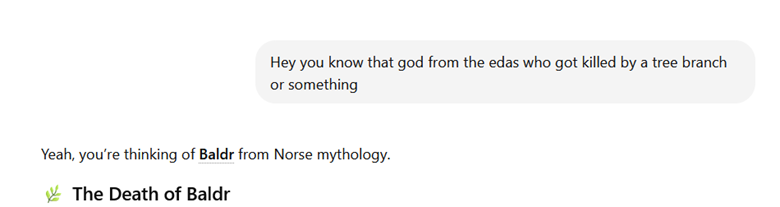
I mean that’s useful. It can also link you to sources and videos for your actual research. In any case, this is a good springboard for actual research.
2. Brainstorming
You can ask it questions about books. It has not read most books because of copyright. But, it knows their dustjackets and reviews from social media.
If you are looking to write something and want to check up on ‘market saturation’, for example, you can check that out easily.
You could ask, ‘Hey buddy! Can you find out if there are a lot of books about teenage witches and giant robots?’
NOTE: It took a good five minutes thinking about this question. And, it came up with this:
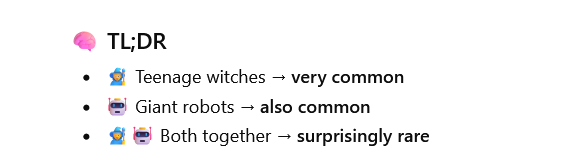
Now from here, you might want to probe a bit to see if there isn’t a similar genre.
Obviously, this was not a great answer, but when I probed further it was able to give me one or two examples.
3. Random Lists
Sometimes you are writing a book about angels and demons working together. And you get 40 000 words in before you realize that it is just Good Omens. Well done, you’ve just made Good Omens, but worse. Nice job Brain!
But it might have been nice for Terry Prattchett if he could have had ChatGPT generate him a list of Angel and Demon names from the bible.
I asked, ‘Can you give me a list of ten angels and 10 demons that would make good character names. They should be historical or biblically accurate. Muslim and Jewish holy texts are also okay.’
It gave me the following:
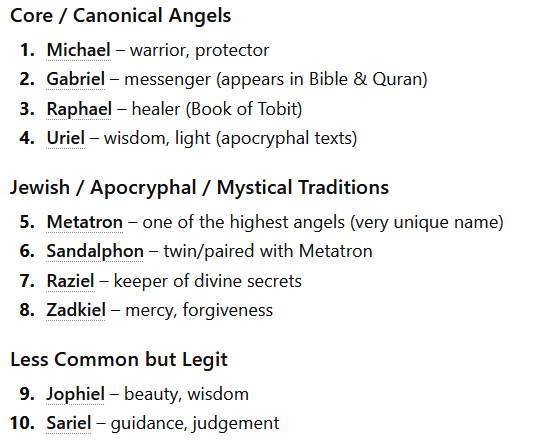
It did the same for demons. They are a bit basic I grant you, but I have recently watched a show that uses most of these names.
Some more ways to use AI in a good way: 8 Ways To Jumpstart Your Writing With Artificial Intelligence
B) Really Bad Uses – How To Lose Your Integrity As A Writer
1. Doing Detailed, Deep Research.
You can use AI for academic research. If you pay for the expensive options that have access to journals and papers. It can do this. But, you are looking at hundreds of dollars a month for this if you are not part of an institution.
What you get with basic Chat GPT, Gemini etc. is a bot that cannot access these articles. So, what it can tell you is limited to what people write about that topic for free on the internet. Meaning it will always be somewhat weighted towards opinion and not the facts.
Even if it is not very wrong, you can never be 100% sure about what you are getting.
2. Writing Your Novel For You.
If you have a free account with these AIs they almost certainly own whatever they produce. Thus, if they write a book for you it is in fact owned by their company. It goes without saying you might be able to get away with posting this on Amazon if it only sells 10 copies.
But, if you somehow sell 10 000 copies and someone finds out you plagiarized the work this can mean you are liable to repay all that money that you have no doubt already spent. Fraud is also a crime and you can face criminal prosecution for it.
Now, if you had your own AI and you made it make you novels. That is still fraud if you put your name on it.
3. But, Is It Even Worth It?
Well, some people make quite a lot of money doing this. But, it is not easy. They spend as much time instructing an AI to do a good job as you would just writing a good book.
The benefit is that they are able write and publish three books a month doing this. Most will be a waste of time. Both in the sense they are regurgitated nonsense, and also that that person spent weeks making a book nobody will ever read.
But, if they can spam enough books to the point they are selling a thousand books a month. That can be serious money if you sell a book for $6-10.
4. Is This A Good Thing To Do
Of course not. Don’t do this.
Being an author is about adding to the sum total of human knowledge; not making content for the content mills.
It’s one thing coming up with an idea based on some research you got from AI, but what these people do is use that AI to research what is selling well and what keywords to use to get it to the top of the Amazon charts.
The AI then writes a book based on whatever it has been trained on. Then they go through it to make it more SEO friendly and sellable. These are not authors but, they would make good SEO specialists.
The Last Word
I can’t stop you from using AI in your day-to-day or even in your work. Nor will I tell you not to. This is actually an issue for your Ethics, your Morals, and your Self-Respect.
What are you okay with?
As I have said, you can use AI to make your life easier at least until the bubble pops and it becomes hugely expensive to use. So, maybe don’t get too attached.
But, are you really a writer if you let it do the hard work for you? Is that creativity? Or is it just an undead synthesis of the machine and the unholy, mocking your human ability to produce things that are new and fresh?
I don’t know. You probably don’t either. It’ll be interesting to look back on this in 10 years.
I’ll let you think about that.
Source for image: Pixabay

Written by Christopher Luke Dean. Christopher writes and facilitates for Writers Write. Follow him on Twitter: @ChrisLukeDean
More Posts From Christopher:
- Horror Movies Are Popular (& Why You Should Write Them)
- The Rule Of Two For Writers
- The Best Fantasy Map Hacks
- What Is Grimdark Fiction & Where Did It Come From?
- Brandon Sanderson’s 3 Rules For Magic
- How Much Technobabble Should You Use in Science Fiction?
- What Is A Cozy Horror & How Do I Write One?
- Which Book Genre Should You Be Writing In 2026?
- The Rules For Writing An Excellent Time Travel Adventure
- 5 Good Things About J.R.R. Tolkien’s Books
7 thoughts on “How To Use AI Without Compromising Your Integrity As A Writer”
Do grammar-checkers count? Although they often get it wrong too – just like Google’s up-front AI precis.
I’ve been using ProWriting Aid since it’s early days (so got a lifetime account for a really good price – yes, that long). I use it to check my grammar and punctuation. Most of its suggestions I ignore, but it does pick up the occasional typo or missing (or extraneous) comma that would take yet another editing read-through. I can use that time to listen to a vocal version instead or send it to my kindle to read it through in a different format without wasting more paper.
I don’t know. I don’t think they did in the past. But, they may be AI powered now. Word and Adobe both have AI options built into their new suits. I don’t use them because I like to write without being bothered. I like the idea of it reading it back to me.
I’m sure that’s a great way to pick up errors.
A sensible article on a contentious topic. Very good to see.
As a professional translator I have to both agree and disagree on the translator part. I agree because I also see translation agencies pushing the use of AI more than needed, but I disagree that the translator will not be needed soon. Being fluent in a language, even one as widely spread as English, is not enough for smoothing out an AI generated text, many other skills are coming into play. My hope is that end clients will eventually realize the poor quality of AI translations and the lack of humanity in them and will ask agencies for more human translations.
On the other hand, even though I am very much against AI, I do use it for a medium level research for my writing. Truth is, it does help in making a vague idea more concrete, like when you don’t even know where to look for the info you want, but it does need a lot of probing to make it give you a reasonable answer and a lot of crosschecking… a LOT of crosschecking!
I agree that there are many Jobs only a translator can do. In person translation for example. But, even then many people prefer using apps to do that now.
What I have heard is that you can train it so well on some tasks in technical fields there is very little actual “work” to do to finish the job.
As someone that loves languages. It worries me that this is the end of an era for a formally white collar slew of jobs.
Many thanks for the article, very interesting read. Another possible “good” use of AI is to feed it a text and ask for a critique of it. You can ask specific questions such as what’s happening in the story, what do you make of the narrative structure or of the motivation of a given character, etc. It is an interesting experience to ask for a gloves-off, totally brutal assessment of the text and see what happens 🙂
The trouble is that AI is programmed to give you positive reinforcement. It’s not a good critic right now even if you ask it to be brutally honest it might not be.
Also, it is lazy. It can skim documents. If you don’t make sure it’s read the whole document it might not!
But, yes it sure is interesting what it comes back with.
Comments are closed.