
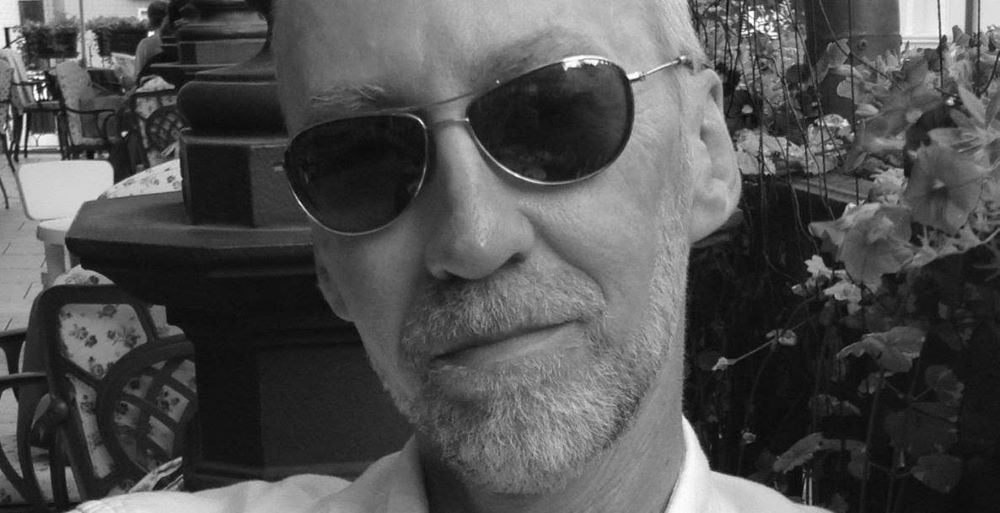
Happy Birthday, Steven Erikson, born on 7 October 1959.
Steven Erikson Quotes
- You start with the commitment: the conviction that you’re meant to do this and nothing else. And then you maintain a strict regimen of disciplined engagement. I write four hours a day when I’m working on a story.
- I don’t do word-counts. I don’t even do page-counts. If I get a paragraph done in those four hours, or if I write twelve pages, either is fine with me.
- As part of my routine, I re-read and edit what I wrote the day before, before starting on fresh stuff.
- I write linearly, starting on page one. No cut and paste, no re-ordering of chapters.
- My notes are sparse and usually involve lists of the characters who will be in a particular scene. Other notes refer to details to aid in description, etc.
- The key is maintaining momentum and keeping alive the sense of immediacy in every scene, not rushing through one to get the next one, which might be more fun. It’s down to respecting each character on the page in front of you, and giving them their time. They all matter, even if only to themselves.
- I delight in wrong-footing readers. I know it’s perverse… As for withholding information, it’s more down to holding to a particular point-of-view, tight with a single character at any one time, seeing only what they think they see, knowing only what they think they know, and believing only what they choose to believe.
- For me it’s important that I enjoy the characters I write about, or rather, those whose points of view I am using. I need there to be something intrinsically interesting in them.
- One might say I fell into genre writing in order to use both plot and drama, and there might be some truth in that.
- The thing’s mapped out so I know what I’m doing (I hope that simply relieves your readers rather than coming across as boastful — really, I do know what I’m doing!) and I can see the light at the tunnel’s end.
- The first half of a novel (for me) always takes longer than the second half. It’s where everything is set up, after all. The second half is the pay-off — which means more action (drama?), which is always quicker to write.
- I worked many other jobs—including archaeology, which I loved—but I never stopped writing or trying to break into publishing. Writing ultimately proved more fulfilling than anything else. What it takes, I think, is stubbornness and persistence.
- Writers must also learn to manage their inner critic. A critic that helps you improve is invaluable; one that destroys confidence is not your friend. Writing requires resilience, not self-flagellation.
- Writing is the act of grappling with an idea until one of you collapses from exhaustion.
- A worthwhile idea should feel daunting, audacious, and challenging—something that questions my assumptions and unsettles me. Then I throw characters at it. Characters must challenge the idea, argue with it, undermine it.
- My outlines evolve as I write. I usually know the ending and where certain characters must arrive, but outlines remain flexible. Characters must be allowed to take control of scenes. If they derail your plan, it may be because the real story is emerging.
- Theme unifies story through language, imagery, tone, and rhythm. Theme is not sacred or fragile—it is simply an exploration of some aspect of the human condition.
- Dialogue can become dangerously self-satisfied. I value restraint—the line loaded with subtext, understatement, and tension, where much remains unsaid.
- When a scene becomes brutally difficult, don’t escape it. Push through. That pressure is where you learn what it means to be a writer.
- Finish what you start.
Source for quotes 1-7: Flexible Head and quotes 8-11: SFF World and quotes 12-20: Better Storytelling
Steven Erikson, an archaeologist and anthropologist, is a bestselling Canadian author. He is best known for his epic fantasy series, the Malazan Book of the Fallen, which has been named one of the top ten fantasy series of all time. The God Is Not Willing marked the beginning of a thrilling new series, The Tales of Witness. Erikson has also ventured into science fiction, writing the comedic Willful Child Trilogy, a spoof of Star Trek and other genre tropes, as well as the First Contact novel Rejoice, a Knife To the Heart. Erikson has said that, alongside an examination of the ‘human condition’, compassion is a central theme and driving force in all his literary work. His writing also explores social inequality, egalitarianism, life, death, history, and historical accuracy. His style is characterised by complex plots and large casts of characters, and he has been praised for his willingness to kill central characters when doing so serves the story. Follow him on Facebook.
Source for photograph: Facebook Page

by Amanda Patterson
Are you interested in more authors’ birthdays? Please click here: The Complete Author Birthday Calendar