
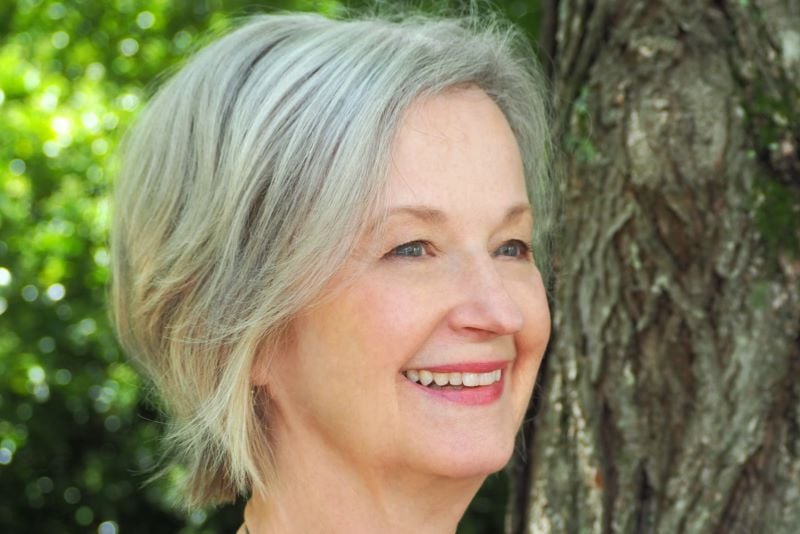
Happy Birthday, Rebecca McClanahan, born on 24 August 1950.
Rebecca McClanahan Quotes
- I don’t have a genre that is my all-time favourite; my favourite varies depending on what I’m most drawn to write at any particular time. Usually ideas work themselves into essays, language play is the beginning of poems, and character- or plot-driven scenarios end up as fiction. But not always. One thing I do know: whatever genre I’m working in is definitely not my favourite at the moment I am writing. Mostly, writing is hard work even when it engenders joy
- I love writing in multiple genres. It’s like cross-training. That’s the way I think of it: a way not only to eliminate boredom with the normal routine but also to increase performance in our predominant sport (well, assuming we have a predominant sport) by training in other sports. Genre-crossing exercises our writing muscles in different ways.
- I definitely feel that my prose has influenced my poetry and vice versa, though perhaps not in the ways you might imagine. From the beginning, I was—by interest and nature, perhaps—a narrative poet. My poems told stories. Almost always. But I find that as time goes on, the more I write essays and stories, the less I tend to tell stories in my poems. More and more, my poems are doing almost everything except tell stories.
- I do know that the writing of fiction—the shaping of character- or plot-driven stories, stories with a recognisable arc—has greatly affected the storytelling quality of many of my essays. Memoir (be it essay-length or book-length) is the most difficult genre I’ve ever worked in, probably because it requires the most destruction, particularly in the early stages of the draft. One has to destroy—or at least deconstruct—what happened before one can make a text out of that happening.
- Lately I’ve been thinking of a structure that might be helpful to beginning memoirists, or to any of us attempting to make a shapely text, a meaningful text, out of what life hands us in the form of raw material. At this point, I’ve got it down to a four-part structure: memory, dismember, remember, memoir.
- What is essential to one piece may not be important at all to another. One work might be voice driven; another might be driven by character or place; another, by theme. What a writer must do, I suppose–at least this is what I try to do as I write and revise–is to locate the essential character of the text that is trying to come forth.
- Even in a short piece, something must change between the first sentence and the last; the work cannot be static.
- One well-chosen physical trait, item of clothing, or idiosyncratic mannerism can reveal character more effectively than a dozen random images. This applies to characters in non-fiction as well as fiction.
- If your character doesn’t yet have a job, a hobby, a place to live, or a place to wander, you might need to supply these things. Once your character is situated comfortably, he may relax enough to reveal his secrets. On the other hand, you might purposely make your character uncomfortable—that is, put him in an environment where he definitely doesn’t fit, just to see how he’ll respond.
- What items would your character pack for a weekend away? What would she use for luggage? A leather valise with a gold monogram on the handle? An old accordion case with decals from every theme park she’s visited? A duffel bag?
- Create a grocery list for your character—or two or three, depending on who’s coming for dinner. Show us the character’s credit card bill or the itemised deductions on her income tax forms. Let your character host a garage sale and watch her squirm while neighbors and strangers rifle through her stuff. Which items is she practically giving away? What has she overpriced, secretly hoping no one will buy it? Write your character’s Last Will and Testament. Which niece gets the Steinway? Who gets the lake cottage—the stepson or the daughter? If your main characters are divorcing, how will they divide their assets? Which one will fight hardest to keep the dog?
- The characters in our stories, songs, poems, and essays embody our writing. They are our words made flesh. Sometimes they even speak for us, carrying much of the burden of plot, theme, mood, idea, and emotion. But they do not exist until we describe them on the page. Until we anchor them with words, they drift, bodiless and ethereal. They weigh nothing; they have no voice.
Source for quotes 1-5: The Kenyon Review and 6-7: River Teeth and 8-12: Writer’s Digest
Rebecca McClanahan is an American poet, memoirist, essayist, and fiction writer. She is the author of 12 books, including In the Key of New York City: A Memoir in Essays, Word Painting: The Fine Art of Writing Descriptively, and Write Your Heart Out: Exploring & Expressing What Matters to You. McClanahan’s awards include the Wood Prize from Poetry, two Pushcart Prizes, the Carter Prize for the Essay, the Glasgow Award in nonfiction for The Riddle Song and Other Rememberings, literary fellowships from the New York Foundation for the Arts and the North Carolina Arts Council, and a Governor’s Award for Excellence in Education. Rebecca currently teaches non-fiction and poetry in the MFA program of Queens University. Her twelfth book, Light Falls on Everything: A Daughter’s Memoir of Caregiving, Grief, and Possibility, was published in March 2026. Visit her website www.rebeccamcclanahanwriter.com.
Source for photograph: Author’s Website

by Amanda Patterson
Are you interested in more authors’ birthdays? Please click here: The Complete Author Birthday Calendar