

Feeling blue? Turn your troubles into poetry! Discover how to write a blues poem and turn life’s low points into powerful poetry.
We got the blues – we all know what it means. The blues is a particular kind of feeling. It’s sadness, yes, but it goes beyond that. There’s hopelessness in there, despair, and depression. There are a million poems about that feeling, right?
It gets interesting when that feeling not only provides the topic for a poem but also its genre. Because then, that feeling of despair can get a very interesting twist.
Let’s talk about where that genre comes from and how you can write your own Blues poem.
The History Of The Blues
It’s a bit like the hen and the egg – nobody knows which came first, the lyrics or the melody. But the musicians came before the poets. So, let’s start with the music. Don’t worry, I’ll keep the theory to a minimum.
What Is Blues Music?
Blues music is both a genre and a musical form that started among the African Americans in the Deep South of the USA in the 1860s.
Certain chord progressions characterise the musical form itself. In poetry, that’s like a rhyme pattern. Both determine how the song (or the poem) goes from one line to the other, and from one stanza to the next.
In Blues music, there’s a call-and-response pattern, a certain repetitiveness (known as ‘the groove’), and then there are ‘Blue notes’, notes which are flattened in pitch. They’re the ones that make this music sound so interesting.
These ‘blue notes’ are notes that create a certain tension. Essentially, they do this by annoying the listener’s expectations. They egg us on; they make us want to listen to the next chord that resolves that tension. They are also the ones that make the sadness of the music transcend that general feeling. This will become important for Blues poetry, too.
Early Blues music started with a single line being repeated four times. In poetry, that would mean: AAAA, with all the words being repeated in each line. Poetically speaking, that’s not very interesting. In the early 20th century, the Blues stanza changed. Now, a typical Blues verse became AAB: three lines with the first two being identical, then rounded off by a third line that usually brings a twist. Here’s an example from a Blues musician called ‘Barbecue Bob’, from his song Yo-Yo Blues No. 2:
‘[…] I got a girl, say she long and tall (x2)
She sleeps in the kitchen with her feets in the hall […]
The incorrect plural in the third line tells us Blues music originated in the oral tradition. The linguistic register is spoken language, colloquial, and even slang. Let’s apply it to writing.
Blues Poetry
You could argue that the first Blues poems were the lyrics written to Blues music (see an example from Bessie Smith below, under ‘Further Reading’). Themes include struggles, hardships, loss, heartbreak, and overcoming adversity in hard times.
In the early 20th century, Blues poetry evolved when writers like Sterling A. Brown and Langston Hughes adapted the form.
They kept the AAB-form as a rhyme scheme but expanded the concept to a stanza structure. This is what the classic form of a Blues stanza now looks like (use this as a blueprint for your own Blues poem!):
Line 1 (A): Introduction
Mention a problem, feeling, or make a statement about difficult times.
Line 2 (A): Repetition
Repeat the first line but introduce a variation. This can be a shift in emphasis, or a change in detail. The change in the second line should show where the problem really hurts.
Line 3 (B): Resolution
This can be many things: an answer to a question within the first two lines, it can subvert the problem, contrast with the problem, or show an alternative, which might even be funny or ironic.
Now we have the rhyme scheme of each stanza. These lines tend to be rather long, with four to six accents (like the phrases in Blues music) with a significant break in the middle. Langston Hughes, for example, broke these long lines in two (see below) to increase the flow of the poem.
You can have many of these triplets, but in popular music, a set of three stanzas is common.
Remember to include something akin to the Blue note in music. This can be a quirky element to vary the repetition of the second line, or a plot twist. Or a complete change in the pattern altogether. Anything is allowed to keep readers on their toes.
Put The Theory Together
Let’s see how a master does it. We’ll read a poem by Langston Hughes, called ‘Morning After’ (1942):
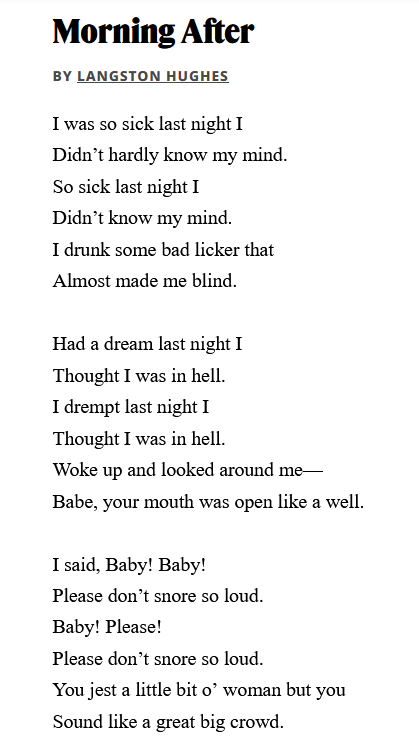
As you can see, Hughes splits the first and second line of the typical Blues stanza into two lines. The variation within the repeated lines does shed a new light on the first line. For example, the second line of the second stanza changes ‘dream’ to ‘I dreamt.’ Hughes makes it clear that the impression of hell is a very personal one. The speaker wasn’t actually in hell.
Now look at the 5th and 6th lines of each stanza. They show the progression of the theme. In the first stanza, the poet gives us the most plausible reason for being in hell – he had too much really bad liquor. The second stanza shifts the attention to the woman he is with. She snores, and her open mouth is obviously not a pretty sight. Stanza 3 adds to this impression, telling us that her snore is deafening. We are left to wonder if he’ll spend another night with her.
How To Write A Blues Poem
| Step | What To Do | How To Do It |
|---|---|---|
| 1. Choose A Problem | Find your subject. | It can be heartbreak, bad luck, work stress, or something as trivial as losing your toothpaste cap. |
| 2. Write Your First Line | Introduce the problem. | State the problem plainly. |
| 3. Repeat It With A Change | Develop the idea. | Repeat the first line, adding a detail that makes the situation more frustrating, revealing, or amusing. |
| 4. Deliver The Twist | Surprise the reader. | Use the third line to introduce a response, contrast, joke, or unexpected turn. |
| 5. Build Three Stanzas | Develop your poem. | Expand your idea across three stanzas, allowing the final line to change how we understand the poem. |
| 6. Experiment With Rhythm | Read your poem aloud. | Adjust the phrasing until it flows naturally. |
Find something you struggle with. Let’s say you struggle with closing the cap on your toothpaste every morning. The second line will be a repetition, but it needs to include a variation. Line three must bring a resolution. You could throw away the toothpaste. For stanzas 2 and 3, you need to widen your focus. Move away from the toothpaste to a larger context. Maybe you’re just not a morning person?
Remember, the last line of your third stanza should then not only give a twist to stanza 3 but ideally, to the whole poem.
If you come up with something, let us know in the comments! We’re eager to read your Blues poem.
The Last Word
The blues is a feeling poets know very well. Now, you have a perfect genre to express it in. Have fun trying it out. Remember, you can also experiment with variations of the stanza form—Hughes himself did it. And if a master does it, so can you! If you’d like to read some more examples of Blues poetry, I have included some below.
Happy writing!
Further reading:
- The Weary Blues by Langston Hughes
- The Po’Boy Blues by Langston Hughes
- Riverbank Blues by Sterling A. Brown
- Backwater Blues by Bessie Smith
- Memphis Blues by Sterling A. Brown
- Sence You Went Away (1922) by James Weldon Johnson
- Father Death Blues (Dont Grow Old Part V) by Allen Ginsberg
Photo by Drew Patrick Miller on Unsplash

By Susanne Bennett. Susanne is a German-American writer who is a journalist by trade and a writer by heart. After years of working at German public radio and an online news portal, she has decided to accept challenges by Deadlines for Writers. Currently she is writing her first novel with them. She is known for overweight purses and carrying a novel everywhere. Follow her on Facebook.
More Posts From Susanne
- What Is Automatic Writing?
- How To Write An Elevator Pitch For Your Novel
- What Is A Pastiche & Why Should You Write One?
- What Is Steampunk? How To Write Steampunk Fiction
- How To Write A Space Opera
- What Is Dystopian Fiction & How Do I Write It?
- What Is Utopian Fiction & How Do I Write It?
- How To Write Alternate History: A Complete Guide For Writers
- How To Create Tension In Storytelling
- 7 Benefits Of Keeping A Diary – For Writers
Top Tip: Sign up for our free daily writing links.