
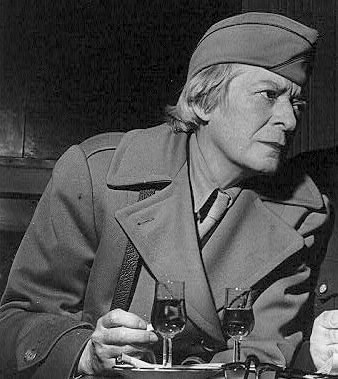
Janet Flanner was born on 13 March 1892 and died on 7 November 1978.
Janet Flanner Quotes
- I keep going over a sentence. I nag it, gnaw it, pat and flatter it.
- History looks queer when you’re standing close to it, watching where it is coming from and how it’s being made.
- Being self-taught, [Hitler’s] mental processes are mysterious; he is missionary-minded; his thinking is emotional, his conclusions material. He has been studious with strange results: he says he regards liberalism as a form of tyranny, hatred and attack as part of man’s civic virtues, and equality of men as immoral and against nature. Since he is a concentrated, introspective dogmatist, he is uninformed by exterior criticism. On the other hand, he is a natural and masterly advertiser, a phenomenal propagandist within his limits, the greatest mob orator in German annals, and one of the most inventive organizers in European history. He believes in intolerance as a pragmatic principle. He accepts violence as a detail of state, he says mercy is not his affair with men, yet he is kind to dumb animals. … His moods change often, his opinions never. Since the age of twenty, they have been mainly anti-Semitic, anti-Communist, anti-suffrage, and Pan-German. He has a fine library of six thousand volumes, yet he never reads; books would do him no good — his mind is made up.
- Genius is immediate, but talent takes time.
- In the history of art there are periods when bread seems so beautiful that it nearly gets into museums.
- I act as a sponge. I soak it up and squeeze it out in ink every two weeks.
Janet Flanner was an American writer and journalist who served as the Paris correspondent of The New Yorker magazine from 1925 until she retired in 1975. While in Paris she became very close friends with Gertrude Stein and her lover, Alice B. Toklas. She wrote under the pen name Genêt. She also published a novel, The Cubical City. In 1966 she won the U.S. National Book Award in the Arts and Letters category for her Paris Journal, 1944–1965. According to Britannica: ‘The letters were characterized from the first by remarkable sensibility, wit, and clarity. Flanner’s reportage was sophisticated, insightful, and cosmopolitan and proved a valuable asset to The New Yorker.’
Source for image: See page for author, Public domain, via Wikimedia Commons
https://commons.wikimedia.org/wiki/File:Jannet_Flanners_(cropped).jpg

Please click here for our Literary Birthday Calendar